
Once the epicenter of one of the largest oil booms in American history, Smackover, a tiny, rural town in southern Arkansas, could soon find itself at the heart of the clean energy revolution — powered not by oil, but by the critical mineral lithium.
Located in one of the poorest areas of the U.S., Smackover and surrounding communities in south Arkansas are above the Smackover Formation, an ancient limestone aquifer that stretches underground from Florida through Alabama, Mississippi, Louisiana and southwest Arkansas to eastern parts of Texas.
Thousands moved to the boom town of Smackover in the 1920s to get rich off vast reserves of black gold nearby.[1] A century later, lithium prospectors have already packed their bags.
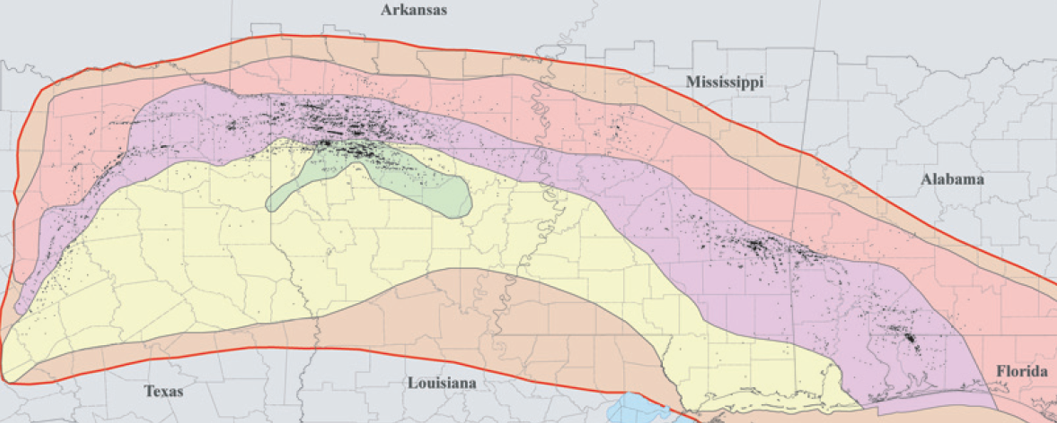
Portions of the Smackover Formation in south Arkansas and east Texas hold vast reserves of lithium — the critical mineral powering electric vehicles, energy storage systems, and data centres. A 2024 U.S. Geological Survey study estimated between 5 and 19 million metric tonnes of lithium in underground brine reserves in southern Arkansas alone — with even the low-end figure exceeding nine times the International Energy Agency’s projected global car battery demand for 2030.[2] If successfully tapped, those reserves could drastically reduce America’s dependence on China, the world’s largest lithium refiner and producer of lithium-ion batteries.
“The world needs Arkansas and needs Smackover [lithium extraction] to work,” Simon Moores, managing director of Benchmark Mineral Intelligence, said during the annual Arkansas Lithium Innovation Summit last October in Little Rock, the state capital. “The exciting thing about here is there are not many resources in the world that can actually increase lithium output in these increments.” [3]
Much of the Smackover Formation’s promise for lithium production hinges on whether the burgeoning industry there proves commercially viable, whether domestic supply chains can be built out, and whether new extraction technologies now being tested can deliver battery-grade lithium at scale.
Policymakers in India would be wise to follow developments closely. While some hype surrounds the Smackover’s potential as a major player in global lithium supply chains,[4] it represents an evolving case study worth tracking — particularly as India introduces new laws to encourage private-sector investment in domestic mineral exploration and pursues international cooperation in critical minerals.[5] Certainly KABIL, the government backed joint venture tasked with forging overseas critical mineral deals for India, might find inspiration.[6]
An overview of the Smackover Formation, the companies involved in lithium extraction in south Arkansas, the policies supporting the industry’s growth, the technology ecosystem, and the challenges, is a worthwhile study.
The Smackover: A history of resource extraction
The Smackover Formation has a long history of resource extraction. Discovery of a sizeable oil field near the town of Smackover in the 1920s resulted in an oil boom, with the region becoming the leading producer of oil in the world by 1925. Since then, oil and gas have been drilled from Arkansas and neighboring states, including Louisiana and Texas, for decades. Oil and gas producers also discovered that brine waters, a byproduct of oil and gas extraction, were a valuable source of bromine, a versatile chemical compound used for flame retardants, water treatment, pharmaceuticals, and various other industries. The land surrounding the town of Smackover still produces a large percentage of the world’s commercially available bromine today.[7]
But those bromine-rich brine waters also contain other minerals, including lithium, and in some areas around Arkansas and east Texas, high concentrations of it. Interest in extracting lithium from Smackover brine started about two decades ago and increased as global demand for powerful battery technologies has exploded. New lithium extraction technologies have also emerged and the U.S., as well as many other countries, now view securing a domestic supply of critical minerals as not just a matter of convenience, but also a matter of national security,[8] a stabilising factor as new funding sources and favorable policy updates mitigate risk in the highly volatile sector.
The Smackover Formation is not the only new region for lithium mining in the U.S.
In Nevada, the Thacker Pass project, a joint venture between Canada’s Lithium Americas and General Motors, is advancing, with phase one completion sometime in 2027.[9] Upon the completion of the first phase, Thacker Pass is expected to produce 40,000 tonnes of battery-quality lithium carbonate annually. Phase two will produce double that amount. U.S. automaker General Motors has signed an offtake agreement of production volumes from phase one for 20 years and about 40 percent of phase two production volumes for 20 years. The project also received a $2 billion loan from the U.S. Department of Energy to finance the first phase.[10]

Completion of the first phase of the Thacker Pass project has been a long time coming. There were multiple, lengthy delays involving stakeholder opposition to the mine, which required layers of state and federal permits to even begin construction. Legal battles from environmental and tribal groups halted forward movement for years – a roadblock to Lithium Americas’ ability to de-risk the project and to secure financing.[11]
From brine to battery: policy foundations in the Smackover
One of the value propositions for companies developing lithium extraction projects in the south Arkansas portion of the Smackover Formation is that pieces of the regulatory framework are already in place from the bromine industry.
That existing experience and permitting structure has streamlined the development of the lithium business. The average time to bring a new mine into operation in the U.S. is almost 30 years, which, behind Zambia, is the second longest mine development time in the world, according to a 2024 report from S&P Global Market Intelligence.[12] Litigation risks in the U.S., as referenced with the Thacker Project, “may explain why exploration budgets committed by investors to Canada and Australia [mining projects] over the last 15 years have been 81 percent and 57 percent higher than to the U.S.,” the S&P Global report said.[13] (State and federal lawmakers are proposing or passing a range of new laws that would expedite permitting requirements.)[14]
“We have a stable, proven, predictable regulatory and statutory framework in Arkansas and a history and familiarity with the production process used to produce lithium based on the fact that it is almost the same extraction process that we have been using for bromine from the same source,” Arkansas Secretary of Energy and Environment Shane Khoury said during a 2025 interview. “The Smackover Formation exists in all these states, but we are the only state that has been producing brine from that formation. Companies [operating in south Arkansas] could see the statutes and the production history and have experience with us regulating this resource in the past. Other states frankly just don’t have that.”[15]
Indeed, some companies with a long operating history in the Smackover Formation are pivoting toward lithium. Albemarle Corporation, headquartered in Charlotte, North Carolina, has produced bromine from brine in southern Arkansas since the 1960s. The company controls extensive acreage and infrastructure in the region and, in recent years, has begun piloting direct lithium extraction technologies at its facilities near Magnolia, Arkansas. Direct lithium extraction, or DLE, refers to a group of emerging technologies designed to extract lithium from brines more selectively and potentially more efficiently than traditional methods.[16] It’s being tested for commercial viability in the Smackover Formation not only by Albermarle but also other major energy players, including ExxonMobil and Chevron.[17]
Conventional lithium mines, like Albemarle’s Salar de Atacama operation in Chile, one of the largest lithium operations in the world, rely on evaporation ponds to extract lithium. The ponds require huge tracts of land, strain local water resources and take months – or longer – to evaporate so that lithium can be processed from concentrated brine. Hard rock mining, common in Australia, also has limitations, including high costs and environmental damage.[18]
In contrast, DLE involves selectively isolating lithium from brine using chemical or adsorption-based processes. Compared to traditional evaporation methods, DLE has the potential to use less land and water, achieve higher lithium recovery rates, and produce results in days rather than months—though performance varies by technology and project.[19] Significant challenges remain around scaling, cost, and consistency at commercial levels. Still, because of the high-quality brines in the Smackover Formation, the region has emerged as one of the most important testing grounds for DLE in the U.S.
Smackover Lithium, a joint venture between Canada’s Standard Lithium and Equinor of Norway, is emerging as a key player to watch. In March, Smackover Lithium announced it had signed its first commercial offtake agreement for its $1.45 billion DLE project in southwest Arkansas with Trafigura, the Singapore-based multinational commodities trading group. Smackover Lithium will supply Trafigura with 8,000 tonnes per year for 10 years of battery-quality lithium carbonate when commercial production begins at the southwest Arkansas plant.[20]
The agreement is a key milestone for the joint venture to reach FID, or final investment decision, a critical stage for mining projects to advance to full-scale construction and deployment. The U.S. Department of Energy also awarded Smackover Lithium’s southwest Arkansas project a $225 million grant for the construction of a processing facility.[21] Executives said they received “expressions of interest” of more than $1 billion in financing from several export credit agencies, including the Export-Import Bank of the United States and Export Finance of Norway.[22]
Meet the lithium tech bros
On a balmy early spring day at the end of March 2026, the people of Texarkana, a border town split between Arkansas and Texas, were formally introduced to Teague Egan, a 37-year-old entrepreneur and investor, who didn’t look like he was from around there — because he isn’t.
With a sun-kissed tan, chiseled biceps, perfectly coiffed red hair and dressed in standard Silicon Valley all-black attire, Egan bounded onto an also-all-black stage, complete with a fog machine and custom hype song, for “GET-Lit at Lonestar,” the launch event for the eponymous Project Lonestar, a DLE demonstration plant operated by Energy Exploration Technologies, Inc., or EnergyX — the start-up energy technology company founded by Egan in 2018.
Using EnergyX’s patented “GET-Lit” DLE technology, the Lonestar demonstration plant — on the Texas, not the Arkansas, side of Texarkana — will produce 250 tonnes of battery-grade lithium carbonate from Smackover brine annually, according to the company.[23]
The goal: Commercial expansion of a scalable, low-cost lithium processing supply chain across the U.S.
“We have lost sight of lithium technology innovation in the U.S. China is a decade, maybe two, ahead of us in critical minerals,” Egan said in a flashy “hype” video for Project Lonestar’s launch event on March 26 near Texarkana. “We are really taking a SpaceX-Tesla approach where we have to procure and develop our whole supply chain because it doesn’t exist.”[24] (Egan was an early investor in Elon Musk’s Tesla, so it’s not a coincidence that he took inspiration for the name of his company, EnergyX, from another one of Musk’s ventures, SpaceX.)
EnergyX, and its tech-bro-esque founder, are worth noting for a couple of reasons.
First, Egan is broadly correct that the U.S. lags China in critical supply chain infrastructure needed to convert lithium—whether from the Smackover Formation or elsewhere—into battery-grade chemicals and downstream components used in EVs, energy storage, and solar systems.
Without that infrastructure, lithium from the Smackover Formation likely would still have to be shipped to China, the world’s dominant lithium refiner and processor. “It just makes no economic sense to pay transport costs to move product to Asia to be processed and then ship it back here for the batteries to be made in [the U.S.],” Standard Lithium CEO David Park said at the 2025 Arkansas Lithium Innovation Summit. “From a producer perspective and from the economics of the supply chain, there is waste in the system we could eliminate.”[25]
Which is where entrepreneurs, like Egan, come in.
“This industry does not change much. It has literally not changed in the past 100 years,” Egan said at the March 26, 2026, “GET-Lit at Lonestar” event, also livestreamed, of course. “There has been zero innovation until now. Everyone told us this was impossible. They said DLE technology does not work. No one will license the technology from you because you can’t prove it. Teague, you’re an outsider.”[26]
Outsiders might just be the key to success for an American lithium revolution.
Amidst the frenzied rush for the U.S. to secure its own sources and supply chains of critical minerals, a new batch of start-ups are emerging focused on innovation in mining, a strategic advantage that, according to a February 2026 Council on Foreign Relations report, could enable the U.S. to “leapfrog China’s dominance by scaling disruptive innovation, recovery, and recycling, which is cheaper, cleaner, and faster to deploy today and could help insulate the U.S. from future supply shocks.”[27]
Arkansas is already moving in this direction.
The Arkansas Lithium Technology Accelerator (ALTA), a partnership between the University of Arkansas, Standard Lithium and an Arkansas-based entrepreneur support organisation, is the first accelerator in the U.S. focused on lithium innovation in American battery supply chains. ALTA accepts cohorts of early-stage and growth-stage companies working on lithium-related technologies, providing access to industry contacts, policymakers, research institutions and investors.[28] With the assistance of state workforce development grants, Arkansas universities and technical colleges are developing professional training programs to bolster a skilled workforce to support the lithium industry in the Smackover Formation[29] – if, of course, the industry doesn’t go bust first.
The Smackover Formation, South Korea – and India?
While on his first state visit to India in April 2026, South Korean President Lee Jae Myung sat down for an exclusive interview with the Times of India during which Lee discussed increased cooperation between India and South Korea for the development of critical minerals. “India possesses critical minerals, while Korea has the capabilities to manufacture them into rechargeable batteries, electric vehicles and other advanced products,” Lee said. “This makes our two countries ideal partners for generating synergy. By moving beyond the traditional model of importing raw material and combining Korea’s technology with India’s mining and refining industries, we can work together to establish stable critical mineral supply chains.”[30]
South Korean companies are already inking deals in the Smackover Formation. In June 2024, ExxonMobil signed a non-binding agreement with South Korean EV battery maker SK On, which has the potential to be a multi-year offtake deal of up to 100,000 tonnes of lithium from ExxonMobil’s first planned project in Arkansas.[31] SK On operates plants in Georgia and is building more U.S. facilities via joint ventures with Ford Motor Co. and Hyundai Motor Group. ExxonMobil signed a similar agreement with LG Chem, a battery parts maker, in November 2024. LG Chem would use the lithium at its $3.2 billion Tennessee cathode manufacturing facility.[32] (Also of note, at the end of 2025, Korea Zinc announced – in partnership with the U.S. Department of War and U.S. Department of Commerce – it would build a more than $6 billion critical minerals refinery in Tennessee.)[33]
India could adapt the logic of U.S.- Korea lithium cooperation by securing upstream resources through overseas partnerships, including with companies in the Smackover Formation, while building domestic midstream refining capacity. By importing raw or semi-processed lithium and converting into battery-grade materials at home, India could reduce its dependence on Chinese processing, capture higher value segments of the supply chain and attract JVs with Korean firms seeking diversification away from China.
Of course, to encourage the development of its own domestic lithium resources as well as new supply chain capacity, India first requires some essential ingredients: a transparent and stable regulatory framework, technical expertise, innovative technologies and critical infrastructure, including accessible logistics hubs and high-capacity, reliable electrical grids. Indian policymakers should keep a close eye on the Smackover Formation as a blueprint.
Lara Farrar is an award-winning journalist with more than 20 years of experience. She was previously a foreign correspondent in China.
This article was exclusively written for Gateway House: Indian Council on Global Relations. You can read more exclusive content here.
Support our work here.
For permission to republish, please contact outreach@gatewayhouse.in
©Copyright 2026 Gateway House: Indian Council on Global Relations. All rights reserved. Any unauthorised copying or reproduction is strictly prohibited.
[1] “Smackover (Union County).” Encyclopedia of Arkansas. Central Arkansas Library System. Accessed May 5, 2026. https://encyclopediaofarkansas.net/entries/smackover-union-county-1000/.
[2] Knierim, Katherine. “Unlocking Arkansas’ Hidden Treasure: USGS Uses Machine Learning to Show Large Lithium Potential in the Smackover Formation.” U.S. Geological Survey National News Release, October 21, 2024. https://www.usgs.gov/news/national-news-release/unlocking-arkansas-hidden-treasure-usgs-uses-machine-learning-show-large.
[3] Moores, Simon. “Keynote Address: Benchmark Mineral Intelligence – Arkansas Rising.” Lecture presented at the Arkansas Lithium Innovation Summit, Little Rock, AR, October 28, 2025.
[4] Cline, Elizabeth L. “Will Arkansas’s Big Bet on Lithium Benefit All of Us, or Just the Wealthy Few?” Arkansas Times, November 14, 2025. https://arktimes.com/arkansas-blog/2025/11/14/will-arkansass-big-bet-on-lithium-benefit-all-of-us-or-just-the-wealthy-few.
[5] Ministry of Mines, Government of India. National Critical Mineral Mission (NCMM). New Delhi: Ministry of Mines, January 2025. https://mines.gov.in/admin/storage/ckeditor/NCMM_1739251643.pdf.
[6] India, Ministry of Mines. “KABIL Is Exploring Opportunities for Acquisition of Overseas Critical Minerals Assets in Argentina, Australia and Chile.” Press Information Bureau press release, July 31, 2024. https://www.pib.gov.in/PressReleaseIframePage.aspx?PRID=2039606®=3&lang=2.
[7] Interstate Oil and Gas Compact Commission. “Arkansas’ Brine Production Business.” Paper presented at the Annual Business Meeting of the Interstate Oil and Gas Compact Commission, 2021. https://oklahoma.gov/content/dam/ok/en/iogcc/documents/abm/2021/brine_paper.pdf.
[8] U.S. Department of State, Office of the Spokesperson. “2026 Critical Minerals Ministerial.” Fact Sheet. February 4, 2026. https://www.state.gov/releases/office-of-the-spokesperson/2026/02/2026-critical-minerals-ministerial.
[9] Lithium Americas Corp. “Thacker Pass: Overview.” Accessed May 5, 2026. https://lithiumamericas.com/thacker-pass/overview/default.aspx.
[10] Lithium Americas Corp. “Thacker Pass Overview Video.” YouTube video. Accessed May 5, 2026. https://www.youtube.com/watch?v=rfHazRiDmtU.
[11] Alonzo, Amy. “Questions over Water Rights Could Halt Construction at Thacker Pass Lithium Mine.” The Nevada Independent, June 30, 2025. https://thenevadaindependent.com/article/questions-over-water-rights-could-halt-construction-at-thacker-pass-lithium-mine.
[12] Bonakdarpour, Mohsen, Frank Hoffman, and Keerti Rajan. Mine Development Times: The U.S.in Perspective. Prepared for the National Mining Association. New York: S&P Global Market Intelligence, June 2024. https://cdn.ihsmarkit.com/www/pdf/0724/SPGlobal_NMA_DevelopmentTimesUSinPerspective_June_2024.pdf.
[13] Ibid.
[14] Trump, Donald J. Executive Order 14241, “Immediate Measures to Increase American Mineral Production.” March 20, 2025. Federal Register 90, no. 57 (March 25, 2025): 13673. https://www.whitehouse.gov/presidential-actions/2025/03/immediate-measures-to-increase-american-mineral-production/.
[15] “A Proven, Predictable Framework: Arkansas Energy Chief on the State’s Lithium Advantage.” Lithium Link, accessed May 5, 2026. https://www.lithium-link.com/news/a-proven-predictable-framework-arkansas-energy-chief-on-the-states-lithium-advantage.
[16] Albemarle Corporation. “Albemarle’s Roots Run Deep in Magnolia, Arkansas.” Albemarle News, accessed May 5, 2026. https://www.albemarle.com/global/en/news/albemarles-roots-run-deep-magnolia-arkansas.
[17] “Chevron Makes Move into U.S.Lithium Sector with Acreage Buy.” Reuters, June 17, 2025. https://www.reuters.com/business/energy/chevron-makes-move-into-us-lithium-sector-with-acreage-buy-2025-06-17/.
[18] “Lithium Extraction Methods.” Lithium Harvest Knowledge Base. Accessed May 5, 2026. https://lithiumharvest.com/knowledge/lithium-extraction/lithium-extraction-methods/.
[19] Mousavinezhad, Seyedkamal, Sheida Nili, Ario Fahimi, and Ehsan Vahidi. “Environmental Impact Assessment of Direct Lithium Extraction from Brine Resources: Global Warming Potential, Land Use, Water Consumption, and Charting Sustainable Scenarios.” Science of the Total Environment (2024). https://doi.org/10.1016/j.scitotenv.2024.074382.
[20] Trafigura. “Trafigura Signs Battery-Grade Lithium Carbonate Offtake Agreement with Smackover Lithium.” Press release, 2026. https://www.trafigura.com/news-and-insights/press-releases/2026/trafigura-signs-battery-grade-lithium-carbonate-offtake-agreement-with-smackover-lithium/.
[21] Smackover Lithium. “Arkansas Lithium Project Finalized USD $225 Million Award.” Press release, 2025. https://smackoverlithium.com/newsroom/news-details/2025/Arkansas-Lithium-project-finalized-USD-225-million-award/default.aspx.
[22] Smackover Lithium. “Smackover Lithium Receives Indications of Interest for Over $1 Billion in Project Finance for the South West Arkansas Project.” Press release, 2025. https://smackoverlithium.com/newsroom/news-details/2025/Smackover-Lithium-Receives-Indications-of-Interest-for-Over-1-Billion-in-Project-Finance-for-the-South-West-Arkansas-Project-2025-Re7RUz0ucF/default.aspx.
[23] EnergyX. “American Made Lithium Project: Lonestar.” Press release. Accessed May 5, 2026. https://energyx.com/press-release/american-made-lithium-project-lonestar/.
[24] “EnergyX Lonestar Project Video.” YouTube video. Accessed May 5, 2026. https://www.youtube.com/watch?v=iqm9K2J99wE.
[25] Park, David. “The Missing Midstream.” Panel discussion at the Arkansas Lithium Innovation Summit, Little Rock, AR, October 28, 2025.
[26] EnergyX. “GET-Lit at Lonestar” Full YouTube livestream video. March 26, 2026. https://www.youtube.com/live/DXdjxQF2WvM.
[27] Crebo-Rediker, Heidi, and Mahnaz Khan. Leapfrogging China’s Critical Minerals Dominance: How Innovation Can Secure U.S. Supply Chains. Council Special Report no. 101. New York: Council on Foreign Relations, February 2026. https://www.cfr.org/reports/leapfrogging-chinas-critical-minerals-dominance.
[28] Venture Center. “ALTA 2 Accelerator.” Accessed May 5, 2026. https://www.venturecenter.co/accelerators/alta-2/.
[29] “Lithium Works Program Offers Pathways to New Industry Jobs.” Lithium Link, accessed May 5, 2026. https://www.lithium-link.com/news/lithium-works-program-offers-pathways-to-new-industry-jobs.
[30] “South Korea Working with India to Secure Hormuz Security; Security of Key Maritime Routes Essential for Survival of Both Nations, President Lee.” Times of India, accessed May 5, 2026. https://timesofindia.indiatimes.com/india/south-korea-working-with-india-to-secure-hormuz-security-of-key-maritime-routes-essential-for-survival-of-both-nations-president-lee/articleshow/130380123.cms.
[31] ExxonMobil. “ExxonMobil, SK Lithium Supply Agreement.” News release, June 25, 2024. https://corporate.exxonmobil.com/news/news-releases/2024/0625_exxonmobil-sk-lithium-supply-agreement.
[32] ExxonMobil. “ExxonMobil and LG Chem Sign MOU for Lithium Offtake.” News release, November 20, 2024. https://corporate.exxonmobil.com/news/news-releases/2024/1120_exxonmobil-and-lg-chem-sign-mou-for-lithium-offtake.
[33] Korea Zinc. “Korea Zinc Partners with the U.S. Department of War and U.S. Department of Commerce to Build a State-of-the-Art Critical Minerals Smelter in the United States with $6.6 Billion of Capital Expenditures.” Press release, December 15, 2025. https://www.koreazinc.co.kr/en/korea-zinc-partners-with-the-u-s-department-of-war-and-u-s-department-of-commerce-to-build-a-state-of-the-art-critical-minerals-smelter-in-the-united-states-with-6-6-billion-of-capital-expenditures/.