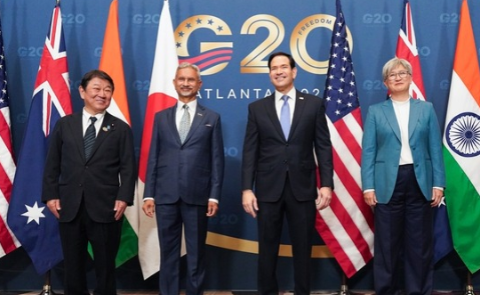
The periodical swirl of speculation around whether the Leaders’ Summit of Quad countries – the U.S., India, Japan, and Australia – will be held has begun. This time, the focus is on the chances of the meeting taking place in Manila, on the sidelines of the November 15-18 ASEAN summit and its related meetings. Insiders say that, subject to confirmation of President Donald Trump’s participation, the four leaders are certain to meet in a bid to re-energise this plurilateral grouping by investing it with the highest level of political support.
The Quad, as it has developed since 2017, has functioned to secure two principal goals. The first is to project the participants’ resolve to balance and constrain China’s coercive actions and assertive policy in the Indo-Pacific region. The second is to win and retain friends and partners for the Quad’s vision of a Free and Open Indo-Pacific (FOIP), first enunciated by Japan in 2016.
The Quad is now an integral part of the foreign policies of the four participating countries – three treaty allies (the U.S., Japan, and Australia) and one common strategic partner (India). Between September 2019 and October 2026, the foreign ministers of the Quad held a total of 13 meetings, three of them in 2026 alone – May (New Delhi), July (Manila), and October (Atlanta). The leaders held six meetings between March 2021 and September 2024, of which two were online. If the next summit takes place later this month, it will be the first to include President Trump.
Much substantial work has been done at the level of foreign ministers. At the meeting in Delhi, they said their mission was to help countries determine “their own paths.” They reiterated the importance of adhering to the United Nations Convention on the Law of the Sea (UNCLOS). Besides, they articulated their common position on the four pillars of Quad’s mandate:
– Maritime and transnational security
– Economic prosperity and security
– Critical and emerging technology, and
– Humanitarian assistance and emergency response.
The Delhi meeting produced four documents: the Quad Foreign Ministers’ Meeting Joint Statement, the Factsheet, the Critical Minerals Initiative Framework and a statement on Indo-Pacific Energy Security. Together, they reflected members’ harmonised positions on energy security and critical minerals. The negotiated Factsheet also outlined the Quad’s achievements over the past year, including the launch of the Indo-Pacific Maritime Surveillance Collaboration (IPMSC), the expansion of the Indo-Pacific Partnership for Maritime Domain Awareness (IPMDA), and the subsequent development of a comprehensive Common Operating Picture (COP).[1]
The Delhi meet was followed by an hour-long consultation of the foreign ministers in Manila in July, held on the sidelines of ASEAN-related events. Manila sent out a strong message conveying the Quad’s support for ASEAN centrality and unity, as well as the ASEAN Outlook on the Indo-Pacific (AOIP).
That said, the Quad is often surrounded by contradiction. Take ASEAN. It remains a crucial player for both the Quad grouping and economically for China in the broader context of the U.S.-China strategic rivalry and the complex relations that Japan, India, and Australia maintain with China today. Then there is the growing proximity between Washington and Beijing, newly developed over a series of one-on-one meetings between President Trump and President Xi Jinping in Busan, Beijing, and Washington over the past 12 months. The present U.S. policy to promote a constructive relationship with China, based on “strategic stability”, will certainly need to be harmonised with the Quad and the diplomatic baggage it carries.
Overall, however, the Quad has been long on announcements and short on delivery, especially since the Trump 2.0 administration began its innings in January 2025. The latest Quad foreign ministers’ meeting that took place in Atlanta, Georgia, on October 31, had the usual joint press release on economic prosperity and security, the importance of building “reliable and open global supply chains” and “grave concerns regarding economic coercion”, shorthand for negative actions by China. It added a new concern about the “proliferation of online and cyber scams” that threaten national and international peace and security. And the Quad held the first-ever Business Leaders Forum, a receptacle of commercial diplomacy that is to be convened soon.
It ended with the ministers stating that they “look forward to the convening of the Quad Leaders’ Summit” and to continuing the ministerial work to “advance peace, stability, and prosperity in the Indo-Pacific and beyond.” U.S. Secretary of State Marco Rubio stressed that the U.S. administration wanted the Quad to focus on practical deliverables and regular projects rather than just holding talks and making pronouncements. If he is serious, it will be a welcome development from the Trump administration.
As the chances of the Quad summit taking place in Manila have brightened, China’s unease seems to have increased. In Atlanta, Marco Rubio said, “The Quad was not an anti-China or anti-anybody coalition.” Still, while not naming China, he said concerns about the Quad’s activities came from one country.
For now, all four Quad members have a position on China. President Trump is scheduled to travel from Manila to Shenzhen, China, to attend the Asia-Pacific Economic Cooperation (APEC) summit. After meeting Xi Jinping there, he will be ready to receive him in Miami, Florida, for the G20 meeting in mid-December. India and Australia are anxious to preserve the recent progress achieved in their respective relations with China. Japan-China ties, however, remain strained. In this light, the world will be watching closely how the Quad summit pronounces itself on China’s threat and on the weight of the Quad’s own role in the Indo-Pacific region.
Rajiv Bhatia is the Distinguished Fellow for Foreign Policy Studies and a former diplomat who served in Jakarta as DCM and in Yangon as Ambassador.
This article was first published in Hindustan Times.
References:
[1] Bhatia, Rajiv. ‘The Quad, Reset’. Articles. Gateway House: Indian Council on Foreign Relations, 28 May 2026. https://www.gatewayhouse.in/the-quad-reset/.