In 2022, Western governments imposed the hardest sanctions on Russia, over 26,000 as of 2025,[1] the most comprehensive on any major economy since World War II. Russia, a known high-technology player, was cut off from Western semiconductors, software, capital markets, and technology partnerships immediately after its “special military operation” in Ukraine.[2] Nvidia chips became inaccessible. Big tech companies like Microsoft and Oracle suspended their operations.[3] Over 550 companies’ tech has since moved out of Russia, and over 320 more are withholding investments or scaling back.[4] In this scenario, Russia’s technology sector and its ambition of building a sovereign artificial intelligence (AI) ecosystem should have collapsed.
It did not. Russia’s AI market was valued at $6.3 billion in 2025 and is estimated to reach $47.5 billion by 2034.[5] AI has become a major focus in Russia in recent years, and it is reflected in the discussions at the St Petersburg International Economic Forum (SPIEF), 2026, where at least 27 of 150[6] sessions focused on AI.[7] President Putin reiterated that his government is hard at work, building a sovereign AI ecosystem.[8]
Sanctions bring self-reliance. Russia has built its own large language models (GigaChat and YandexGPT), its own neuromorphic chip (ALTAI) and its own national healthcare AI platform (MosMedAI) deployed across 74 regions and 2,000 hospitals.[9] It has its own international AI alliance with 28 member countries. More than 52% of large organisations in Russia are implementing AI in their operations.[10]
At this time, Russia is not a global AI contender at the level of the U.S. or China, largely due to its digital isolation. Brain drain is also a concern, with over 100,000 technology professionals having left Russia since 2022.[11] At least eight companies originally founded in Russia, such as OZ Forensics, Retail Rocket, and Diagnocat, have relocated abroad.
But Russia has built something that most sanctioned economies have not: a functioning, sovereign AI ecosystem that is growing and expanding internationally. Understanding how it did this matters not just for Russia-watchers, but for any country seeking to build AI capability outside the Western or Chinese technological mainstream. That includes India.
This infographic maps the over three dozen AI companies operating in or originating from Russia, examining their ownership structures, state connections, product categories, and the linkages between their usage by the state and the civilians.
Figure 1: Russia’s AI stack
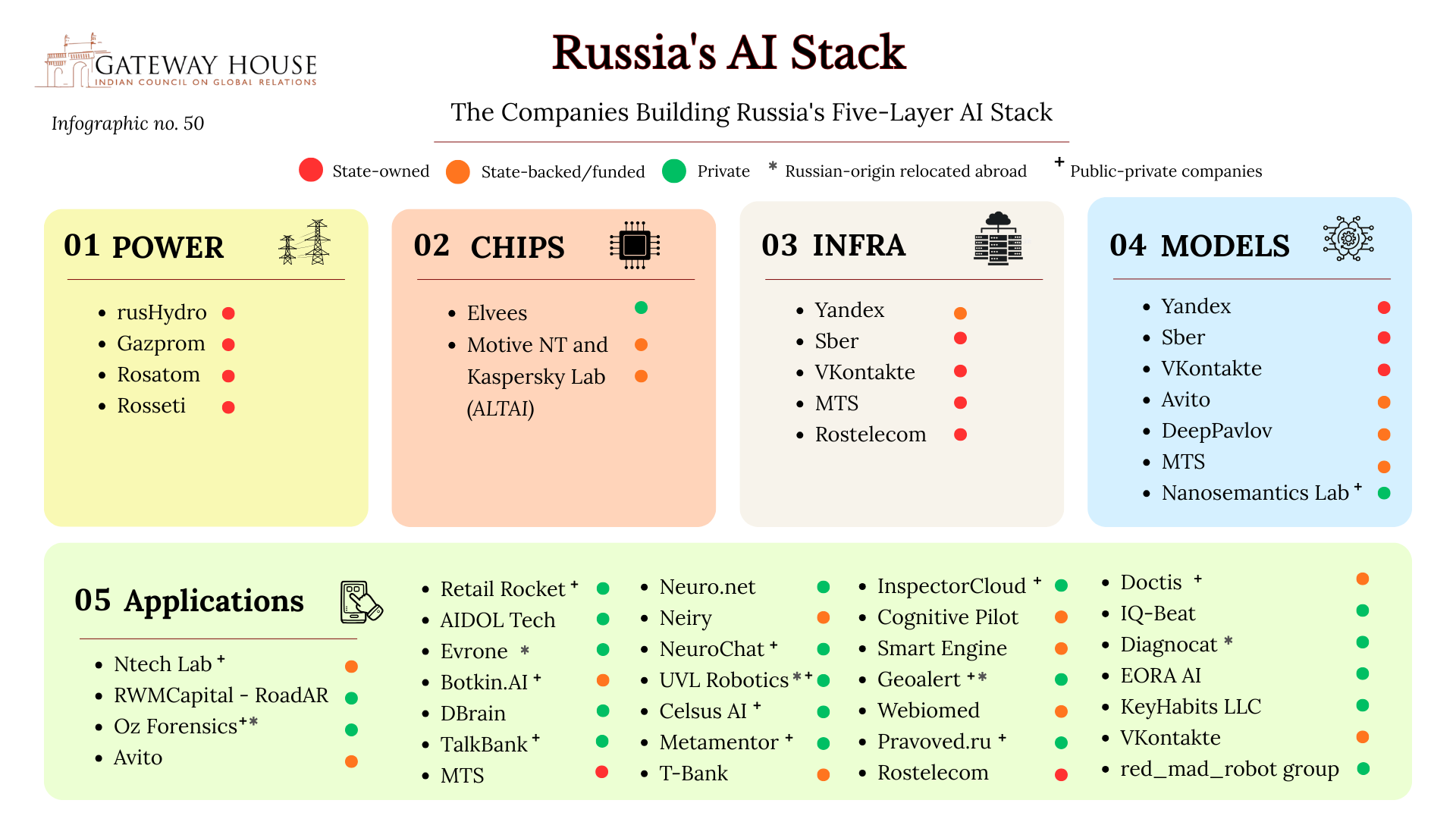
Source: Gateway House compilation
Prior to 2022, Russia’s technology sector was significantly, and predictably, dependent on Western infrastructure.[12] Companies used Amazon Web Services (AWS), Google Cloud and Microsoft Azure for cloud computing; Western social media platforms like Facebook, YouTube and Instagram; and Google Search and ChatGPT.
When ChatGPT became inaccessible and Western cloud services withdrew, domestic alternatives appeared: Sberbank’s GigaChat, also known as Russia’s ChatGPT, was launched in 2023.[13] Yandex developed its own language learning model (LLM) – YandexGPT – in 2023.
Russian medical technology, which is considered world-class, grew 21.4% in 2025, following 18% growth in 2024, with a proliferation of AI in medtech. In 2024, Russia launched MosMedAI, a state initiative to standardise and scale AI-powered radiology and medical imaging across Russia’s public healthcare system. This platform currently offers 17 AI services designed to assist radiologists in detecting various conditions.[14]
Figure 2: The Russian MedTech market (2025)
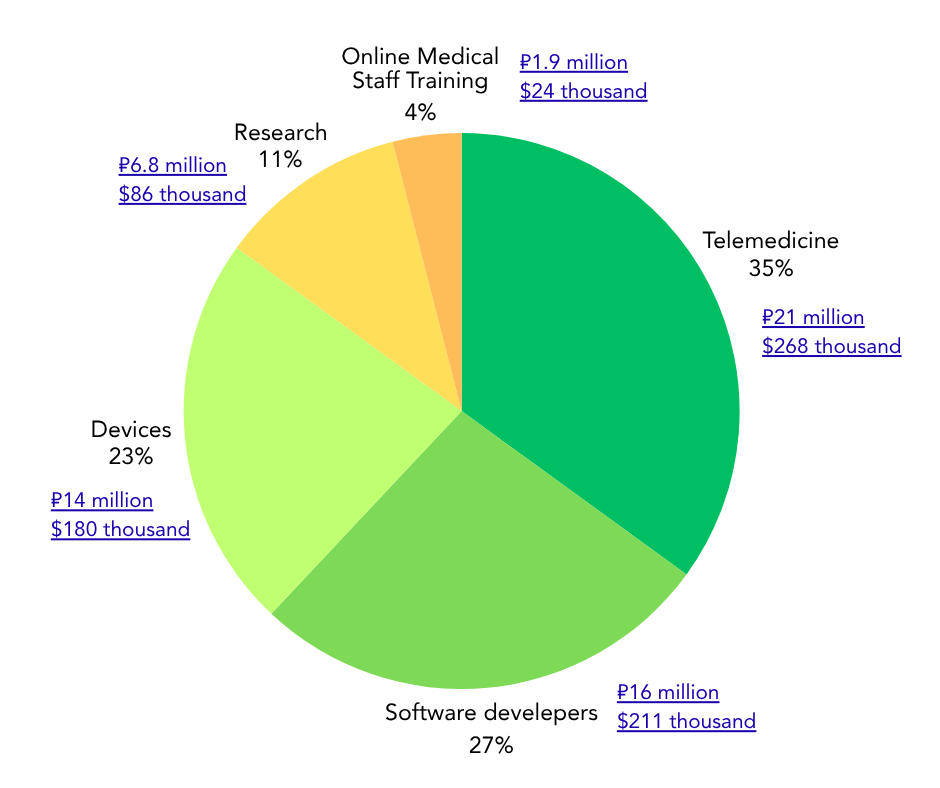
Source: Smart Ranking Russia [15],[16]
The Russian government played a significant role. In March 2022, when it looked like the war with Ukraine would drag on, Presidential Decree No. 83 was issued, which allowed faster development of the IT industry, allocation of funds from the federal budget for workers and institutions, and tax exemptions.[17] The Kremlin acted as a deliberate ecosystem architect by identifying the gaps created by Western withdrawal and systematically filling them with funded domestic initiatives. It is also the primary financier – unlike the U.S., where AI development is driven by private venture capital, and China’s hybrid model, where the state sets goals and policies and the private sector contributes with investments and execution.
The state enables its AI ecosystem through three channels:
The first is the Skolkovo Foundation, Russia’s government-created technology hub that functions as a combination of tax haven, grant provider, and accelerator for AI startups. Skolkovo gives companies with high commercial potential a 100% tax exemption,[18] grant financing of up to $5 million and a minimum of 50% in co-investments. The state provides intellectual property (IP) protection and provides access to research infrastructure and the business and science communities through the Skolkovo IP centre and shared-use research labs, modern office spaces, testing facilities and on-campus living.[19]
Companies like Webiomed are Skolkovo beneficiaries. Its medical device was registered by the Federal Service for Surveillance in Healthcare (Roszdravnadzor) in 2020 to be integrated into existing healthcare software in Russia and was deployed across the country. [20],[21]
The second channel is the National Technology Initiative (NTI), a state programme for developing future technology markets, which has co-funded companies including Neiry and NeuroChat, both neuro-tech companies. The government as co-founder often absorbs losses – a big encouragement for start-ups doing research and development (R&D).
The third channel is direct investment by state institutions. The Russian Direct Investment Fund (RDIF), Russia’s sovereign wealth fund, used to invest with foreign partners like the Japan Bank for International Cooperation, Kuwait Investment Authority, and Mubadala Investment Company. Now RDIF goes it alone; Rosatom, Russia’s state nuclear corporation, has invested in Botkin. AI, the medical imaging AI company.[22] [23]
Across Russia’s AI ecosystem, the government operates through three distinct mechanisms:
The first mechanism is layered corporate ownership through state-adjacent entities. Sberbank is 50% owned by the Finance Ministry.[24] VKontakte (VK), Russia’s largest online social networking service, is controlled by Gazprom subsidiaries.[25] NTechLab, an AI company that specialises in advanced biometric and video analytic technology whose facial recognition systems cover most of the regions,[26] is 12.5% owned by Rostec, Russia’s state defence corporation.[27] [28]
Figure 3: Russian companies and its AI models

Source: Gateway House compilation
The second mechanism is forced ownership transfer under Kremlin pressure. Oleg Tinkov, the founder of Russia’s leading digital bank T-Bank, formerly Tinkoff Bank, publicly criticised Russia’s invasion of Ukraine. He subsequently claimed he was forced to sell his 35% ownership stake[29] without the opportunity to negotiate under pressure from the Putin administration.[30] The bank was taken over by Interros Group, controlled by sanctioned Russian oligarch Vladimir Potanin.[31]
Avito, Russia’s largest online classifieds and e-commerce site, is now partially owned by the state. In 2025, Russia’s state-owned agricultural bank Rosselkhozbank acquired 50% from Kismet Capital Group, an investment firm controlled by businessman Ivan Tavrin, who acquired Avito in October 2022 from South Africa’s Naspers.[32]
The third mechanism is national policies and laws. On July 8, 2026, Russia’s State Duma passed a bill on the development of AI technologies — the country’s first comprehensive AI law.[33] It introduced a classification of “trusted AI” models, subject to formal security verification by federal bodies like the Ministry of Digital Development, responsible for technical intelligence and information security. Models that receive the “trusted AI” classification get preferential access to state procurement of AI-related products. Those that do not either do not get state funding or get a bare minimum. The law also requires AI systems to demonstrate alignment with “traditional Russian spiritual and moral values”, which include life, dignity, human rights and freedoms, patriotism, citizenship, service to the Fatherland, and the unity of the peoples of Russia, among others.[34] This has been criticised by the domestic IT industry.
Russia may not be a global AI superpower, but despite being severely sanctioned, with thinning private investment and a brain drain, it has built a genuinely distinctive product.
Its sovereign AI stack from chips to foundation models like GigaChat to sector-specific applications to international governance frameworks (the 28-member International AI Alliance, including India),[35] function under the heaviest.
Raveena Shivashankar is the digital media associate at Gateway House.
This article was exclusively written for Gateway House: Indian Council on Global Relations. You can read more exclusive content here.
Support our work here.
For permission to republish, please contact outreach@gatewayhouse.in
© Copyright 2026 Gateway House: Indian Council on Global Relations. All rights reserved. Any unauthorised copying or reproduction is strictly prohibited.
References:
[1] Castellum.AI. Russia Sanctions Dashboard. Accessed August 6, 2026. https://www.castellum.ai/russia-sanctions-dashboard
[2] American Enterprise Institute. The Impact of Semiconductor Sanctions on Russia. Washington, DC: AEI, 2024. https://www.aei.org/wp-content/uploads/2024/04/The-Impact-of-Semiconductor-Sanctions-on-Russia.pdf
[3] Oracle. “Oracle and the Conflict in Ukraine.” https://www.oracle.com/corporate/conflict-in-ukraine/russia/
[4] Yale School of Management. “Over 1,000 Companies Have Curtailed Operations in Russia—Some Remain.” https://som.yale.edu/story/2022/over-1000-companies-have-curtailed-operations-russia-some-remain
[5] IMARC Group. Russia Artificial Intelligence Market. https://www.imarcgroup.com/russia-artificial-intelligence-market
[6] Sberbank India. “SPIEF 2026 Programme: Dates and Key Events for Indian Participants.” https://sber.bank.in/media/publications/spief-2026-programme-dates-and-key-events-for-indian-participants
[7] St. Petersburg International Economic Forum. “Business Programme.” https://forum-spb.ru/en/programme/business-programme/?+date+=date-3+June+2026%2Cdate-4+June+2026%2Cdate-5+June+2026%2Cdate-6+June+2026
[8] At SPIEF 2026, more than 1,000 agreements worth 6.6 trillion roubles ($89.57 billion) were signed, with several involving AI partnerships, including between Sber and the Ministry of Finance, ITMO Highpark and VSP Global, and Financial University and China Media Group.
[9] AuntMinnie Europe. “Moscow Creates Healthcare AI Platform.” https://www.auntminnieeurope.com/imaging-informatics/artificial-intelligence/news/15815698/moscow-creates-healthcare-ai-platform
[10] Sberbank. “Sber Launches AI Healthcare Platform.” https://www.sberbank.ru/en/press_center/all/article?newsID=6c7943a8-91a9-4de1-b6f5-aa2079065e3f&blockID=1539®ionID=77&lang=en&type=NEWS
[11] Council on Foreign Relations. “Russia’s Becoming More Digitally Isolated—and Dependent on China.” https://www.cfr.org/articles/russias-becoming-more-digitally-isolated-and-dependent-china
[12] Atlantic Council. Russia’s Digital Tech Isolationism. Washington, DC: Atlantic Council, 2024. https://www.atlanticcouncil.org/in-depth-research-reports/issue-brief/russias-digital-tech-isolationism/
[13] Sberbank India. “India Plans to Use Sber’s GigaChat across Several Sectors.” https://sber.bank.in/media/news/india-plans-to-use-sbers-gigachat-across-several-sectors
[14] HealthManagement.org. “Moscow’s Healthcare Screen.” 2024. https://healthmanagement.org/uploads/article_attachment/hm6-24-25-moscows-healthcare-screen.pdf
[15] Smart Ranking. “Russian MedTech Enters the Era of AI Medicine.” https://smartranking.ru/ru/analytics/medicinskie-tehnologii/rossijskij-medteh-vstupaet-v-epohu-ii-mediciny/
[16] RUB-USD conversions are based on the average 2026 exchange rate
[17] President of Russia. “Address of the President of the Russian Federation.” March 16, 2022. http://en.kremlin.ru/events/president/news/67893
[18] Federal Tax Service of Russia. Tax Code of the Russian Federation, Part Two. https://www.nalog.gov.ru/html/sites/www.eng.nalog.ru/Tax%20Code%20Part%20Two.pdf
[19] Skolkovo Institute of Science and Technology. “Skolkovo Presentation.” 2015. https://back.skoltech.ru/storage/app/media/archive/2015/10/Fertman_presentation.pdf
[20] Webiomed. “Registered Medical Devices Using Artificial Intelligence.” https://webiomed.ru/blog/zaregistrirovannye-meditsinskie-izdeliia-ai/
[21] Webiomed. “The Map: Artificial Intelligence in Russian Healthcare.” https://webiomed.ru/en/blog/the-map-artificial-intelligence-in-russian-health-care/
[22] Rosatom. “Images for Artificial Intelligence.” Rosatom Newsletter, January 28, 2021. https://rosatomnewsletter.com/2021/01/28/images-for-artificial-intelligence/
[23] Rosselkhozbank, Russia’s state agricultural bank, acquired a 50% stake in Avito, Russia’s largest classifieds platform with an active AI model.
[24] Sberbank. “Sber Announces New AI Initiative.” https://www.sberbank.ru/en/press_center/all/article?newsID=11028575-1-2&blockID=1539®ionID=77&lang=en&type=NEWS
[25] VK was founded in 2006 by Pavel Durov. In 2014, Durov fled the country, and oligarch Alisher Usmanov, Putin’s close aide, acquired 52% of the shares in MF Technologies, the holding company that controls VK. Then in December 2021, Usmanov sold his shares to Sogaz, an insurance company that is a subsidiary of Gazprom, Russia’s state gas giant. At the same time, Gazprombank, another Gazprom subsidiary, transferred its existing stake in MF Technologies to Gazprom-Media, a third Gazprom subsidiary. The end result: two Gazprom subsidiaries together hold 68% of MF Technologies. Since Gazprom is 50.2% owned by the Russian government, the Kremlin effectively controls VK through state-linked subsidiaries.
[26] VSquare. “Kremlin Leaks Reveal Russia’s AI Surveillance System.” https://vsquare.org/kremlin-leaks-russia-putin-ai-surveillance-facial-recognition-ntechlab/
[27] Rostec. “Rostec to Invest in Face Recognition Technology.” https://rostec.ru/en/media/news/rostec-to-invest-in-face-recognition-technology/
[28] Cognitive Pilot, a tech company which designs AI-driven agricultural machinery and urban public transport, is a joint venture in which Sberbank holds 30%.[28] None of these are formally government property, but neither do they operate independently.
[29] Martin, Iain. “Russian Tycoon Oleg Tinkov Sells Bank Stake to Oligarch Vladimir Potanin.” Forbes, April 28, 2022. https://www.forbes.com/sites/iainmartin/2022/04/28/russian-tycoon-oleg-tinkov-sells-bank-stake-to-oligarch-vladimir-potanin/
[30] Financial Times. “Potanin Acquires Tinkoff Stake.” 2022. https://www.ft.com/content/41b887c4-ed52-4cf0-8a6f-394d578ea6a2?syn-25a6b1a6=1
[31] Interros. “Interros Acquires a Stake in Tinkoff Group.” https://interros.ru/en/press/releases/interros-acquires-a-stake-in-tinkoff-group/
[32] Avito. “Rosselkhozbank Acquires a Stake in Avito.” https://www.avito.ru/company/press/avito-rshb
[33] TASS. “Russia’s Economy…” https://tass.com/economy/2157507
[34] Russian House in New Delhi. “Decree of the President of the Russian Federation No. 809.” https://india-new-delhi.rs.gov.ru/en/doc/decree-of-the-president-of-the-russian-federation-of-november-9-2022-no-809/
[35] Launched in December 2024 by President Vladimir Putin, Russia’s International AI Alliance (the AI Alliance Network) unites national AI associations from BRICS countries and other partner nations. https://aianet.org/members