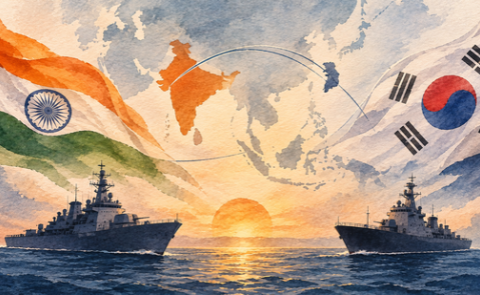
When the Korean industrial giants like Samsung and LG expanded into India in the mid-1990s, they chose an uncommon path: establishing wholly owned subsidiaries rather than joint ventures. That decision signalled exceptional long-term confidence in the Indian market. In the auto sector, Korea introduced India to the iconic Santro. At the same time, India offered Hyundai a demanding environment to test and refine its engineering under some of the world’s most challenging road conditions.
That commercial foundation is now expanding into a broader strategic relationship. India and Korea are pivoting from simple buyer-seller transactions toward co-developing strategic capabilities in patient infrastructure capital, deep-tech venture funding, Indian Ocean maritime security, and defence manufacturing.
This strategic alignment took center stage in April 2026 during Korean President Lee Jae-myung’s state visit to India. Then, Indian Prime Minister Narendra Modi and President Lee declared the partnership a “global good” dedicated to bringing peace and progress to a turbulent world.
To chart this trajectory, Gateway House in Mumbai collaborated with Seoul’s Korea Institute for International Economic Policy (KIEP) and the Institute of Foreign Affairs and National Security (IFANS) to publish a landmark compendium, Korea-India: Strategic Cooperation in Finance and Maritime Domains (Gateway House Report No. 62, November 2026).
In his foreword, Ambassador Rajiv Bhatia suggests instituting an annual, think-tank-anchored dialogue between Gateway House and Korean policy institutes to provide the intellectual ballast this evolving alliance needs. Here are the top four takeaways distilled from the compendium’s flagship research papers.
Paper 1
India’s Emerging Developmental State: The Role of State-Owned Infrastructure Development Financiers, by Dr Kyunghoon Kim (Korea Institute for International Economic Policy)
“India’s true developmentalist hallmark lies in using sophisticated, market-aligned state financial instruments (like NIIF and NaBFID) to de-risk infrastructure and crowd in global capital, all while strictly insulating commercial public sector banks from systemic financial vulnerability.“
A common assumption among global financial analysts was that as India cleaned up its banking sector, the state would retreat from infrastructure financing. Commercial numbers show a clear pullback: public sector banks reduced their share of commercial credit to infrastructure construction from nearly 90% in 2014 to 68% by March 2026. This discipline helped drive gross non-performing assets (NPAs) down from a peak of 14.6% in 2017-18 to 2.6% in 2024-25.
However, Kim shows that India did not abandon state-led infrastructure. Instead, Prime Minister Modi’s economic governance pioneered a model of “new developmentalism”—resembling activist state regimes in Brazil under President Lula da Silva and Indonesia under President Joko Widodo. Rather than burdening commercial banks, the government established specialised state financiers: the National Investment and Infrastructure Fund (NIIF, 2015) and the National Bank for Financing Infrastructure and Development (NaBFID, 2021). These entities supply long-term “patient capital” to de-risk complex projects and crowd in private global investment.
For Korea, entities like NaBFID — which offers long-term loan tenors of 15 to 30 years alongside Partial Credit Enhancement products – provide an institutional bridge. State-backed Korean funds, including the Export-Import Bank of Korea (KEXIM), the Korea Investment Corporation (KIC), and the National Pension Service (NPS), can use these instruments to move beyond saturated high-income markets and deploy patient capital into high-yield, state-de-risked Indian infrastructure.
Paper 2
Exploring a Role for the Republic of Korea in India’s Deep-Tech Startup Sector, by Amit Bhandari (Gateway House: Indian Council on Global Relations)
“Rather than relying on broad regulatory or tax lobbying—or expecting the Indian government’s modest Fund-of-Funds to compete with the hundreds of billions being raised by global AI firms—India should apply the spatial cluster model that successfully anchored Korean manufacturing giants directly to venture capital and deep-tech startups.“
Look beneath India’s headline economic numbers, and an uncomfortable split emerges. While Foreign Direct Investment (FDI) inflows reached an all-time high of $94.8 billion in 2025–26, annual startup funding dropped from its 2021 peak of $42 billion to $10-12 billion between 2023 and 2025.
Amit Bhandari points to a structural bottleneck: Indian venture capital remains concentrated in consumer-facing sectors like fintech and e-commerce. At the same time, deep-tech fields such as AI and semiconductors face severe funding shortages. Meanwhile, global portfolio capital has shifted — resulting in nearly $50 billion in net Foreign Portfolio Investment (FPI) outflows from India over 18 months — to chase AI and chipmaking leaders in the U.S. and East Asia, such as Nvidia, Samsung, and SK Hynix. Because legacy Indian IT services firms (such as TCS, Infosys, and Wipro) lack the risk appetite to fund early-stage deep-tech hardware and product ventures, India faces a widening capital gap.
The author argues that India should not rely on tax lobbying or modest government grant funds. Instead, India should adapt the spatial cluster model that successfully anchored Korean industrial giants (such as Hyundai in Sriperumbudur, Samsung/LG in Noida, and Kia in Anantapur) to venture capital and deep-tech startups. Bhandari recommends establishing a dedicated Korean VC hub near Navi Mumbai Airport and a Korean startup hub in the Delhi/Jewar region.
Choosing Jewar is strategic: it connects Korean technology firms directly to northern India’s broad industrial manufacturing base, rather than Bengaluru’s narrower IT-services ecosystem. Supported by “soft infrastructure” – such as Korean-language interpreters, dedicated healthcare, Korean schooling, and direct flights from Seoul to Mumbai, Bengaluru, and Chennai – these spatial clusters can bridge Korea’s hardware leadership with India’s market scale.
Paper 3
Deepening the Republic of Korea-India Maritime Cooperation: Strategy and Key Priorities, by Dr. Wondeuk Cho (Institute of Foreign Affairs and National Security / KNDA)
“Korea should pair its transfers of decommissioned ships with Maintenance, Repair, and Overhaul (MRO) packages and spare-parts support anchored at Indian shipyards… creating a direct security spillover from bilateral shipbuilding cooperation and offering smaller Indian Ocean states a sustainable alternative to China’s debt-based infrastructure.“
Over 60% of global seaborne trade and two-thirds of global oil transit the Indian Ocean, yet Korea lacks an independent maritime intelligence footprint in the region. Conversely, while India serves as the primary security provider in the Indian Ocean Region, it faces naval budget and procurement constraints.
Building on Korea’s accession to India’s Indo-Pacific Oceans Initiative (IPOI) and the signing of the Comprehensive Cooperation Framework on Shipbuilding, Shipping and Maritime Logistics under the VOYAGES agreement, Dr Wondeuk Cho outlines a “joint support” model for third-country maritime capacity building. This framework combines India’s local diplomatic networks with Korea’s naval hardware, capital, and shipbuilding capacity to assist island and coastal states such as the Maldives, Sri Lanka, Mauritius, and Seychelles.
Dr Cho highlights an operational lesson from Southeast Asia, where transferred patrol vessels often have operational availability rates below 30% because of inadequate maintenance. He argues that Korea must pair its vessel transfers with Maintenance, Repair, and Overhaul (MRO) packages and spare-parts pipelines hosted directly at Indian shipyards.
This co-production framework delivers tangible regional security spillovers. It provides smaller island nations a non-debt alternative for defence infrastructure while securing guaranteed non-combat port replenishment access (at ports including Chennai, the Andaman Islands, Oman, and Sabang in Indonesia) for Korean merchant shipping and the Korean Navy’s Cheonghae anti-piracy unit.
Paper 4
Forging a Partnership Paradigm: India-Republic of Korea Maritime and Industrial Relations, by Lt Gen S. L. Narasimhan (Gateway House: Indian Council on Global Relations)
“If Seoul simply treats India as an export market rather than a co-production partner, these competing objectives will pull the two nations in opposite directions… The solution lies in shifting away from pure finished-goods sales toward subsystem manufacturing and joint ventures anchored inside Defence Industrial Corridors.“
Lt. Gen. S. L. Narasimhan points to a friction point that quiet diplomatic statements often gloss over: India’s push for indigenous manufacturing and technology transfer under Atmanirbhar Bharat contrasts with South Korea’s drive to export finished defence equipment. Treating India merely as a market for exports risks pulling the two partners in opposite directions.
Lt. Gen. Narasimhan outlines stark structural realities: over 90% of India’s trade volume travels by sea, yet India holds less than 1% of the global shipbuilding market. Furthermore, 95% of India’s subsea internet cables land at a single location in Mumbai, creating an operational vulnerability. Conversely, Korea commands 27.34% of global shipbuilding but faces domestic market saturation, high labour costs, and space constraints.
To resolve the export-versus-localisation tension, Lt. Gen. Narasimhan proposes shifting from finished-goods sales to subsystem manufacturing and joint ventures inside India’s Defence Industrial Corridors in Tamil Nadu and Uttar Pradesh, which offer 74% FDI via the automatic route. Significant mutual gains exist in pairing Korea’s semiconductor capabilities with India’s indigenous unmanned underwater and aerial drone platforms. Additionally, linking Korea’s commercial shipbuilders to Gujarat’s ship-recycling ecosystem (which handles 35.4% of global volume) establishes a green lifecycle partnership for maritime assets.
To conclude, the relationship between India and Korea has outgrown the traditional model of branch offices and finished product sales. Across infrastructure finance, deep-tech venture funding, regional maritime security, and defence co-production, the alignment between New Delhi and Seoul is structural and complementary.
Korean companies came to India in the 1990s expecting a large market. They discovered something else: a large market, complex regulations, a strong democracy with phenomenal diversity, high aspirations, and customers who negotiate harder than any stakeholder. The Korean investment model in India has been distinctive: unlike other expansion models based on technical collaborations and joint ventures, many Korean companies established wholly-owned subsidiaries in India. It reflects the confidence with which Korean companies approached the Indian market.
Fast forward three decades, the global supply chains have reconfigured, and regional maritime security has grown more complex. Now, the key goal is for India and Korea to move beyond bilateral transactions to jointly anchor the economic, technological, and strategic architecture of a free, open, and resilient Indo-Pacific.
Ashish Bharadwaj is the Distinguished Fellow for Law and Education at Gateway House.
You can download the full paper here.
This article was exclusively written for Gateway House: Indian Council on Global Relations. You can read more exclusive content here.
Support our work here.
For permission to republish, please contact website@gatewayhouse.in
© Copyright 2026 Gateway House: Indian Council on Global Relations. All rights reserved. Any unauthorised copying or reproduction is strictly prohibited.