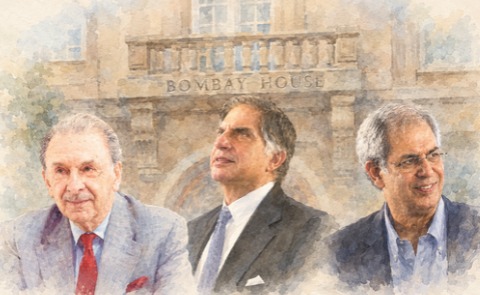
October 9 is the second death anniversary of Ratan Tata, former Chairman of the Tata Group, a leader revered and admired by millions around the world. It is an appropriate time to assess how the Tata family sees the role of the group in India today, given the current challenge to the family’s 150-year legacy.
It is a dispute over whether to list Tata Sons, the unlisted parent company of the $180 billion group, that has stood the test of time since 1868. There are divisions among the trustees over the continuation of an executive chairman. On one side is Noel Tata, Chairman of the Tata Trusts and successor to Ratan Tata. On the other is N. Chandrasekaran (Chandra), the appointed Chairman of Tata Sons, in which the Trusts are the majority (66%) shareholder. Those who knew both the previous patriarch, JRD Tata, and Ratan Tata will find it poignant to see this unfold.
The reasons are many, but primary amongst them is the role the Tata family saw for themselves: first and foremost as guardians of the Trusts. Ratan Tata always spoke of himself as a custodian of the Trusts. This inheritance came from JRD Tata, whose offers to those whom he regarded would be good advisors or board members to the group came with caveats. The job carried great responsibility to the nation first, he always reminded, and while the Tatas treated all employees as family and looked after them well, they could not pay much in salary. Joining the Tata Administrative Services, or TAS, was much like joining the country’s prestigious civil services – the Indian Administrative Service (IAS) or the Indian Foreign Service (IFS). JRD – and Ratan Tata – would then hand out books to read on wealth creation, trusts and social responsibility – well before Corporate Social Responsibility became a fashionable term.
Like trusteeship, modesty was also embedded in the Tata family, immediate and extended. When travelling in London or New York to meet friends, Ratan Tata would often ask which bus he could take to meet them for lunch. He shied away from any media reference to him as the “richest man in the country”. Humility was in his DNA. When he was Chairman of the government-owned Air India from 1986 to 1989 (a company the Tatas founded, which the Indian government took over and, years later, handed back to them), he was known to arrive at the check-in counter carrying his own bags, while others walked in with a retinue of porters and an air of self-importance.
Despite JRD Tata’s last wish of being buried in Paris, France, he was no less an Indian patriot than any other. He spent his life in India and gave away his own personal shares in the Tata companies to the Trusts. Ratan Tata followed the spirit of his predecessor and left his shares in his will to the Ratan Tata Endowment Trust and the Ratan Tata Endowment Foundation, for philanthropic causes.
Not much is known publicly about Noel Tata, who has kept away from the limelight. But Noel Tata has worked quietly within the group for decades, building new businesses like Trent, Tata International, and Tata’s recent joint venture with Mercuria in the global oil and commodity trade. He carries the Tata surname much like his older half-brother did: a little shy, but witty and filled with grace and humility. In a country of such great disparity as India, he is a man of simple tastes and not known for an extravagant lifestyle.
At the fireside chat at IIMBlue 2026, Noel Tata said that “the founders never set out to build the biggest company. The companies exist to serve India and to improve the quality of life.” In his first public interview after the conflict between him and Chandra, Noel Tata, in answer to the question of what he considered his primary job, said, “All I have is a couple of trust documents which basically say: we have left this money; do good for India; it was done over a hundred years ago.” The word philanthropy may not even have existed formally in the way we understand it today, but the principle clearly did.”
The introduction of the five-day week, provident fund, and retirement benefits was introduced by the Tata companies long before they became corporate requirements. Tata Sons’ responsibility is to keep increasing the value of the corpus so that the Trusts’ spending power stays ahead of inflation. And the focus of that spending remains largely health and education. If Tata Sons has a strategic mandate around “what India needs”, said Noel Tata, how is that translated into a mandate when the trust also has investors whose primary objective is financial returns? He remarked that some Tata institutions diminished during Ratan Tata’s final years and teams were disbanded, but that his aim is to try and rebuild them.
Clearly, Noel Tata sees himself first as a custodian in the continuum of the legacy that Tata Trusts has built and to pursue his plans to invigorate it in the spirit of his forebears.
The issue is being debated across India by legal experts, the media and the public. Those who carry the Tata name have served India well for generations and should not be hindered from their task by commercialisation of a sacred trust.
Bobby Saigal is a non-resident Indian businessman engaged in the global shipping, oil and gas business, who is also well-known in theatre.
This was exclusively written for Gateway House: Indian Council on Global Relations. You can read more exclusive content here.
Support our work here.
For permission to republish, please contact outreach@gatewayhouse.in
©Copyright 2026 Gateway House: Indian Council on Global Relations. All rights reserved. Any unauthorised copying or reproduction is strictly prohibited.