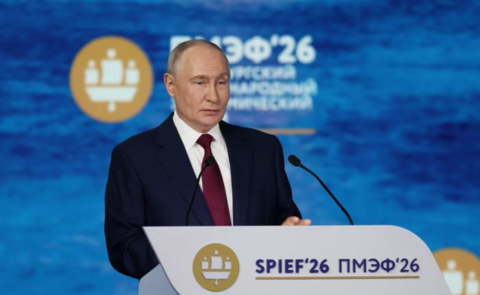
The 29th St Petersburg International Economic Forum (SPIEF) was held in St Petersburg from June 3-6, 2026. The SPIEF has been an annual fixture on the global conference circuit since 1997, when the city of St Petersburg and Russia’s foreign ministry initiated it. Since 2006, the Forum has been held under the patronage and with the participation of the President of the Russian Federation. Despite the ongoing war in Ukraine, this year’s SPIEF brought together over 24,500 participants from 142 countries. The largest delegations were from China, Saudi Arabia, Tanzania, Uzbekistan, the UAE and Kazakhstan, respectively, but for the first time in many years, sizeable delegations from the UK and the EU attended the Forum, along with an official U.S. delegation, also for the first time, led by the Chairman of the U.S. Commission of Fine Arts, Rodney Mims Cook Jr.[1] Along with him was Robert Agee, President and CEO of the American Chamber of Commerce (AmCham) in Russia, who moderated a Russia-U.S. panel discussion.
Regardless, President Vladimir Putin, on his part, specifically focused on the need for Russia and members of the Global South to have technological sovereignty in order to avoid being held hostage to the West.
Russia understands this only too well. At the onset of the war in Ukraine in 2022, one of the first punitive measures that the West imposed on Russia was the banning of Russian banks from the SWIFT international payments and settlement system, isolating Russia from the free movement of goods and services. It also withdrew its software suppliers. Visa and Mastercard suspended their services in Russia on March 5, 2022, halting transactions on Russian-issued cards outside the country while blocking the usage of foreign-issued cards in the country.[2] [3]
The Russian domestic Mir payment system stepped up and has captured a 75% market share in the country, up from 25.7% in 2021.[4] Since its introduction in May 2014, 493.9 million Mir cards have been issued in Russia, according to the Russian Central Bank. [5] A beneficiary has also been China’s UnionPay cards, which work in Russia.
Visa and Mastercard now have less than a 17% share in the Russian domestic market, Alla Bakina, head of the Central Bank’s Payments Systems Department, said[6] at a press conference in May 2026.
At a press briefing on July 2 on the sidelines of the Russian Central Bank’s Financial Congress in St Petersburg, Governor Elvira Nabiullina told reporters[7] that in her view, Visa and Mastercard would “gradually be phased out of circulation, and this is already happening, partly through economic measures.”
How do visitors to Russia manage? Russia has solved the “cash issue” for foreign visitors by enabling foreigners to purchase debit cards at designated banks and even airports. At Moscow’s Sheremetyevo Airport, a foreign visitor can buy a debit prepaid Mir card from Globus Bank by paying in hard currency. The currency is converted to rubles, and the card can be used by the holder without having a Russian bank account.
Putin punched it to the U.S. banks at SPIEF 2026 when he stated that the global development model, long anchored in a limited number of financial centres, technological providers, insurance and logistics hubs, credit rating agencies, and reserve currencies, was under fire.[8] He said this framework, though presented as universal and supposedly neutral, has been increasingly used as a tool to exert political pressure and promote unfair competition, whereby settlements, technologies, logistics, or even access to information could be cut off at a moment’s notice in order to punish countries acting in their own national interests.”
Russia is ensuring it does not get caught off guard again by focusing on AI in finance and other areas. The Russian government has been instructed to prepare a national strategy on autonomous systems and digital platforms modelled on the National Strategy for the Development of Artificial Intelligence that was initiated in 2019. Russia has invested $6.1 billion and involved large state-owned corporations like Rostec and Sberbank to develop AI applications in healthcare, education, national security, agriculture and transportation. It aims to train 6,000 AI specialists a year by 2030. The AI strategy is seen as a model to emulate for a new strategy on autonomous systems and digital platforms.
Not far behind in Putin’s priority was the BRICS, many of whose countries were becoming technological powerhouses. China, for instance, holds the largest number of AI patents (over 183,000 in 2023, according to a Stanford University study[9]), while India accounts for a 17.58% share[10] in the global software market. Putin reaffirmed that Russia is open to work with BRICS partners to build digital infrastructure.
Russia holds a strong position in the pace of adoption of digital and latest technological advancements in online marketplaces, financial solutions, municipal services, healthcare and education, and these adoptions have improved the quality of life for people in Russia. The biggest success story is the unified Public Services (Gosuslugi) portal. Russian citizens see this portal for a variety of services, including applying for driver’s licence and passport applications, insurance, booking medical appointments, registering births, accessing social welfare payments and managing pensions.
Foreigners can pre-register travel details, complete mandatory registration procedures online, apply for work permits and register for university entrance exams.
Cities such as Moscow that are part of a Smart City initiative offer electronic medical cards that keep a record of prescriptions and test results. It also offers a gateway to pay for housing services and utilities.
Over 81% of Russian citizens regularly use government electronic services, a study conducted by VCIOM (Russian Public Opinion Research Center) found in 2024.[11]
Oracle and Atlassian suspended services in Russia, while Alphabet exited the country. Microsoft has suspended new sales but continues to provide access to existing clients.[12]
With no end in sight to the Ukraine war and the sanctions continuously imposed on Russian entities, Moscow also sees India as a key partner. At the Russia-India Business Dialogue held on the sidelines of the SPIEF 2026, where a Federation of Indian Chambers of Commerce and Industry (FICCI) delegation[13] took part, the focus was on collaboration across “innovation, technology, investment and trade”.
A report[14] by Russia’s largest financial institution, Sberbank, said the participants at the forum were interested in digitisation and artificial intelligence being a key part of the $100 billion bilateral trade target set for 2030. India is also negotiating with Sberbank to launch its flagship AI – GIGACHAT in India, the bank said in June.[15]
Bilateral trade between the countries in the 2024-25 fiscal year stood at $68.7 billion from $13.2 billion in 2021-22, but this is heavily dependent on Indian purchases of Russian crude that has been subject to U.S. sanctions.
A key focus area for economic cooperation is now the connectivity of digital payment networks. Moscow and New Delhi have long discussed the integration of the Mir and RuPay. While India’s United Payments Interface (UPI) works in nine foreign countries, talks to integrate Russia into the system have not yielded any results. This is an important area that needs to be developed for Russia and India to build an infrastructure of technological sovereignty.
Ajay Kamalakaran is a writer with a special interest in Russia and the former Soviet Union.
This article was exclusively written for Gateway House: Indian Council on Global Relations. You can read more exclusive content here
For permission to republish, please contact outreach@gatewayhouse.in
©Copyright 2026 Gateway House: Indian Council on Global Relations. All rights reserved. Any unauthorised copying or reproduction is strictly prohibited.
References:
[1] Roscongress Foundation, “Results of the 29th St. Petersburg International Economic Forum,” St. Petersburg International Economic Forum, June 8, 2026. https://forum-spb.ru/en/news/news/itogi-raboty-xxix-peterburgskogo-mezhdunarodnogo-ekonomicheskogo-foruma/
[2] Mastercard, “Mastercard Statement on Suspension of Russian Operations,” Mastercard Newsroom, March 5, 2022. https://www.mastercard.com/us/en/news-and-trends/press/2022/march/mastercard-statement-on-suspension-of-russian-operations.html
[3] Visa Inc., “Visa Suspends All Russia Operations,” Visa Newsroom, March 5, 2022. https://usa.visa.com/about-visa/newsroom/press-releases.releaseId.18871.html
[4] Kirill Kashtanov, “NSPK Proposes Gradual Withdrawal of Visa and Mastercard Cards from Circulation,” Rossiyskaya Gazeta, June 17, 2026. https://rg.ru/2026/06/17/nspk-predlozhila-sposob-postepennogo-vyvoda-kart-visa-i-mastercard-iz-oborota.html
[5] Central Bank of the Russian Federation, “National Payment System,” Central Bank of the Russian Federation, accessed July 9, 2026. https://www.cbr.ru/eng/psystem/
[6] Evgeny Khodakov, “How Is It Translated? Russia’s Payment System Adapts after Visa and Mastercard,” Rossiyskaya Gazeta, May 25, 2026. https://rg.ru/2026/05/25/kak-eto-perevoditsia.html
[7]Bank of Russia, “Briefing by Bank of Russia Governor Elvira Nabiullina”, VK Video, July 2, 2026. https://vkvideo.ru/video-165215852_456240070
[8] resident of Russia, “Plenary session of the St Petersburg International Economic Forum,” President of Russia, 2026. http://en.kremlin.ru/events/president/news/79956
[9] Hanming Fang, “China Leads the World in AI Patents, but Still Learns More from America,” Stanford Center on China’s Economy and Institutions (SCCEI), Freeman Spogli Institute for International Studies, updated May 14, 2026. https://sccei.fsi.stanford.edu/china-briefs/china-leads-world-ai-patents-still-learns-more-america
[10] India Brand Equity Foundation, “Information Technology,” India Brand Equity Foundation, accessed July 9, 2026. https://www.ibef.org/industry/information-technology-india
[11] Russian Public Opinion Research Center (VCIOM), “Our Digital Everyday Life,” VCIOM Analytical Review, May 14, 2024. https://wciom.ru/analytical-reviews/analiticheskii-obzor/nasha-cifrovaja-povsednevnost
[12] Jeffrey A. Sonnenfeld and Steven Tian, “Over 1,000 Companies Have Curtailed Operations in Russia—But Some Remain,” Yale School of Management, originally published February 28, 2022, updated January 28, 2024. https://som.yale.edu/story/2022/over-1000-companies-have-curtailed-operations-russia-some-remain
[13] Federation of Indian Chambers of Commerce and Industry (FICCI), “A Day of Meaningful India–Russia Engagement,” December 8, 2025. https://www.linkedin.com/posts/ficci_a-day-of-meaningful-indiarussia-engagement-activity-7469736346031411200-_Tdu#:~:text=A%20day%20of%20meaningful%20India%E2%80%93Russia,Cooperation%20between%20India%20and%20Russia.
[14] Sberbank India, “Russia and India Discuss USD 100 Billion Trade Target at SPIEF 2026,” June 5, 2026. https://sber.bank.in/media/news/russia-and-india-discuss-usd-100-billion-trade-target-at-spief-2026
[15] Sberbank India, “India Plans to Use Sber’s GigaChat Across Several Sectors,” June 8, 2026. https://sber.bank.in/media/news/india-plans-to-use-sbers-gigachat-across-several-sectors