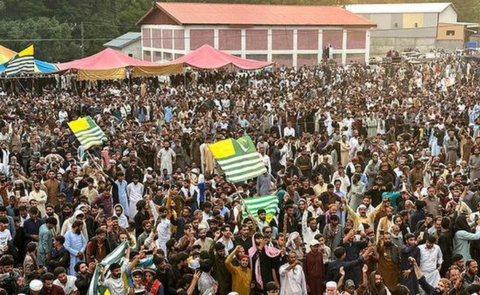
In recent months, Pakistan-occupied Jammu and Kashmir (PoJK), referred to as Azad Kashmir by Islamabad, has been engulfed in a wave of protests since June 5. The demonstrations, fuelled by widespread discontent over escalating prices, oppressive governance, and a glaring absence of accountability, escalated dramatically. By July, the situation had intensified so much that Pakistani security forces responded with unprecedented levels of violence, resulting in the deaths of up to 40 locals, particularly the unarmed protestors affiliated with the Jammu Kashmir Joint Awami Action Committee (JKJAAC), a civil society group. This group has been at the forefront of the peaceful protests, advocating for the rights and voices of the local population.
Compounding the unrest are the ongoing state elections, which began July 27 and whose process has become contentious, marked by violence and turmoil, making them one of the most fractious in recent years. The atmosphere is heavily charged, characterised by internet blackouts and shutdowns, with violent confrontations sparked by the stringent security crackdown.
The protests have focused on a provocative issue: the abolition of 12 legislative assembly seats that are reserved for refugees from Indian-administered Kashmir. The JKJAAC argues that these seats provide undue political influence to “non-residents”, calling for a system where only the “true” residents of Pakistan-administered Kashmir can stand for election and represent the interests of the local populace.
The 12 reserved seats in PoJK were established under the Azad Jammu Kashmir (AJK) Interim Constitution Act of 1974. These were for refugees who fled or migrated from Indian-administered Jammu and Kashmir to mainland Pakistan following the 1947 Partition and the 1965 war. Thousands of individuals, primarily from the Jammu division and the Kashmir Valley on the Indian side, migrated to mainland Pakistan. Most of these refugees and their descendants settled in various provinces of Pakistan, mainly in Punjab, as well as in Sindh and Islamabad.
When the 53-member Azad Jammu Kashmir (AJK) Legislative Assembly was formalised under the AJK Interim Constitution Act of 1974, 12 of the directly elected seats were specifically designated for these diaspora communities, with 6 seats for Jammu refugees and 6 for Kashmir Valley refugees.
The military has firmly resisted the JKJAAC’s demand to abolish the 12 seats because it allows Islamabad’s civil-military establishment to hand-pick winners and control government formation in Muzaffarabad, bypassing local resident voters entirely. As expected in this election too, JKJAAC has accused the Pakistan government of vote-rigging in the 12 reserved seats and of systemic manipulation and operational irregularities.
A majority decision in the Assembly requires the assent of 27 seats. The two competing political parties are the establishment-backed Pakistan Muslim League-Nawaz (PML-N) and the Pakistan Peoples Party (PPP). In the three-phase election, Mirpur voted on July 27, Muzaffarabad and the 12 refugee constituencies on August 2, and Poonch – the JKJAAC stronghold – will vote on August 10. It is Poonch that has become a focal point of tension and violence, experiencing some of the deadliest clashes between protestors and authorities during this turbulent period. In Phase 2, the PML-N has already claimed victory in the majority of the refugee seats.
With security deteriorating, the residents of PoJK are experiencing deprivation at an unprecedented level. An internet shutdown has now been ongoing for over 50 days, making it nearly impossible to campaign or disseminate news from the area. Multiple high-level sources indicate that the Pakistani government has also halted food supplies to the region, leading to stress among sections of the population who were previously uninvolved in the protests. And Islamabad has ordered the temporary shutdown of banks, markets, petrol stations, and other institutions.
The root of these issues lies in a loose trilateral pact signed in October 2025 between the JKJAAC and major political parties like the PPP and the PML-N. The agreement promised to address JKJAAC’s multiple demands from economic subsidies to localised governance reforms one by one – and especially the abolition of the 12 reserved seats. So far, none have been fulfilled.
In late May 2026, formal negotiations between the parties – JAAC and PPP and PML-N – broke down over these demands. On June 5, 2026, the Pakistani government officially banned the JKJAAC under the Anti-Terrorism Act. Authorities simultaneously shut down the internet, raided the group’s offices, and initiated a widespread police crackdown, arresting over 100 leaders and activists. The same day, one of JAAC’s prominent leaders, Umar Nazir Kashmiri, was attacked, resulting in the death of his associate, Shahzeb Habib.
“Branding a grassroots organisation as ‘terrorist’ on vague grounds, while simultaneously cutting the region off from the outside world, raises serious concerns regarding the Pakistani authorities’ conduct and their disregard for human rights. The proscription of JKJAAC under anti-terror laws is disproportionate, unlawful and a violation of the right to freedom of association,” said Isabelle Lassee, Amnesty International’s Deputy Regional Director for South Asia, in a June 9 report.[1] Lassee demanded a reduction of violence, of the protestors and the police, and the upholding of international human rights efforts.
At a time when Pakistan has been trying to actively play the role of mediator in the ongoing West Asia crisis, these incidents on its side of Kashmir have dented its image and are in danger of tarnishing the reputation of Pakistani Army Chief Asim Munir. He is now widely viewed by protesters and regional observers as the central architect behind the iron-fisted state response to the unrest.
The deadly violence and bloodshed in PoJK have also put under question Islamabad’s so-called sincerity in supporting the right to self-determination of the people of Jammu and Kashmir (J&K) across the Line of Control (LoC) on the Indian side.
India has rejected the phased assembly elections in PoJK as a “cosmetic exercise” and a “camouflage” used by Islamabad to mask its illegal occupation and serious human rights abuses. New Delhi maintains that these exercises cannot alter the legal reality that the entire Union Territories of Jammu & Kashmir and Ladakh are integral and inalienable parts of India.
Pakistan, on its part, has predictably accused JKJAAC of being backed, funded, and driven by India. In late July 2026, Pakistan’s Defence Minister Khawaja Asif drew a direct line between the JKJAAC and India during a televised press briefing, thereby ruling out any peaceful negotiations. “There will be no dialogue with the protesters. I bracket them with India. I put them in the same category as India and consider them enemies of Pakistan,” Asif had said.
India’s security apparatus is currently examining the potential connections between the recent terror attacks in Anantnag on July 22 and Kulgam on August 1. These incidents are suspected to be linked to the ongoing unrest in PoJK, highlighting that the Pakistani Army may seize any opportunity to incite similar tensions across the LoC. Both attacks have been attributed to The Resistance Front (TRF), which operates as a proxy for the Pakistan-based terrorist organisation Lashkar-e-Taiba (LeT).
Still, while the Poonch protests continue, Pakistan is unlikely to ratchet up such incidents or launch a large-scale attack in Jammu and Kashmir, mindful that India could swiftly react by resuming Operation Sindoor at any moment.
The surge in tensions is a clear indicator that Pakistan has lost ground in the narrative battle over Jammu and Kashmir. Its claim that Muslims in J&K were being ill-treated is belied by its brutal crackdown in PoJK and neglect of the Kashmiris within its own borders. While it continues to promote cross-border terrorism as a strategy, its grip on the region appears to have slipped beyond recovery, effectively closing the door on any potential for broader India-Pakistan bilateral negotiations in the foreseeable future.
Nayanima Basu is the Adjunct Fellow at Gateway House and an author.
This interview was exclusively recorded for Gateway House: Indian Council on Global Relations. You can read more exclusive content here.
For permission to republish, please contact outreach@gatewayhouse.in.
Support our work here.
© Copyright 2026 Gateway House: Indian Council on Global Relations. All rights reserved. Any unauthorised copying or reproduction is strictly prohibited.
References:
[1] Freedom of Association is provided under Section 7 of the AJK Interim Constitution Act of 1974.