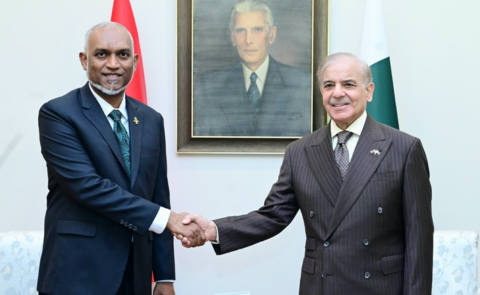
The state visit to Pakistan by the President of the Maldives, Mohamed Muizzu, from October 20 to 22, 2026, has drawn considerable attention in India and elsewhere. ‘What is the Maldives up to?’ deserves an objective answer, set in the larger context of its role in the region’s evolving power dynamics.
A tiny country, with barely 300 km of land area,[1] a population of half a million,[2] and a nominal GDP of $8.5 billion,[3] the Maldives is a cluster of 1,200 islands situated in the Indian Ocean.[4] Governing it is a challenge, given the physical difficulty of connecting and delivering services to people living on far-flung islands. But the country has much going for it: a fiercely independent and proud people, a significant geostrategic location near vital sea lanes, rich tourism opportunities, and abundant fisheries.
A critical look at Muizzu’s foreign policy since he took office in 2023 reveals that he continues to follow the ‘Maldives First’ aim to create and sustain as many international and regional partnerships as possible, without hurting the vital interests of any of its partners. It remains to be seen whether his latest outreach towards Pakistan will have negative implications for India.
But first, it is essential to chart the trajectory of Muizzu’s diplomacy over the past three years. The historical background is clear. Three of his predecessors – Maumoon Abdul Gayoom (1978–2008), Mohamed Nasheed (2008–2012), and Ibrahim Mohamed Solih (2018-2023)[5] followed a largely India-centric strategy, giving primacy to a mutually beneficial and amicable partnership with India. The Presidency of Abdulla Yameen from 2013 to 2018, in contrast, is remembered for his strained and adversarial relationship with India.
Muizzu began on a negative note, driven by his ‘India Out’ campaign, demanding the withdrawal of a small contingent of Indian military personnel in the Maldives. In January 2024, he said that the Maldives respected and trusted India, while asserting that if Indian troops were not withdrawn from the Maldives, it will amount to disregarding the “democratic will” of the Maldivian people and would “imperil the future of democracy in the country”.[6] India agreed, and in May 2024, it began withdrawing its military personnel and replaced them with technical personnel to operate the aviation platforms.[7]
Instead of choosing India for his first visit abroad, Muizzu went to Türkiye first, in November 2023, and then to China in January 2024 and signed 20 agreements. In the same year, the Maldives and China released an action plan for building a ‘Comprehensive Strategic and Cooperative Partnership’ for 2024-2028.[8][9]
After President Muizzu’s visit to China, reality set in, bringing India’s centrality to the Maldives’ external relations to the fore. Malé realised that the expectations placed on China were unrealistic and that it could derive more tangible benefits from India alone. A positive phase in India-Maldives relations followed. Concrete gains and new agreements came after the External Affairs Minister S. Jaishankar’s visit to the Maldives in August 2024, President Muizzu’s visit to India in October 2024 and Prime Minister Narendra Modi’s visit to Malé in July 2025.[10][11]
Three factors led the Maldives to fall back on its traditional preference for a friendly India: first, the weight of a pro-India constituency within the Maldives. Second, the non-fulfilment of excessive expectations placed on China, and third, India’s patient and pragmatic handling of the Maldives file.
In recent years, relations with India have progressed well, with New Delhi stepping in to assist with a series of financial measures like currency swap facilities worth $400 million under the October 2024 agreement[12] and continuing other forms of generous assistance such as extending credit lines amounting to $513 million.[13]
However, recent developments in West Asia, especially the U.S.-Israel war against Iran, have unleashed new forces, creating fresh complications as well as some opportunities for the Maldives. Its inclination to connect with Islamic nations has always been present. This impulse may have grown stronger now, as neighbours like Saudi Arabia and the UAE face serious threats to their security and economic interests. Pakistan stepping in to help Saudi Arabia and forming the Mecca Pact with it and Türkiye in August 2026 has been a significant development for the Maldives. A mix of geography and Islamic affinity has shaped the course of the Maldives’ ties with Pakistan.
President Muizzu’s visit to Pakistan was the first by a Maldivian President in 11 years. The Pakistani Prime Minister, Nawaz Sharif, last visited the Maldives in 2017.
First, as is normal on a state visit, Muizzu met the President and the Prime Minister, but he also met Field Marshal Asim Munir, the Chief of Army Staff and Chief of Defence Forces, showing the Pakistani political elite’s full engagement in upgrading the relationship.
Second, PM Shehbaz Sharif briefed Muizzu on Pakistan’s positions on Jammu and Kashmir and the Indus Waters Treaty. Muizzu said nothing publicly on these issues but spoke of the Maldives’ commitment to playing a constructive and productive role in revitalising the South Asian Association for Regional Cooperation (SAARC), including creating conditions to convene the summit at the earliest possible opportunity.[14]
Third, the two sides signed 20 agreements, covering defence and maritime security, public administration and law enforcement, trade, economy and health, and education, environment and culture.[15]
Fourth, the two governments set a target to increase trade from the current $13.9 million to $200 million over the next two years.
Fifth, Muizzu announced that Maldivian, the national airline, will soon start direct flights between Malé and Karachi.
Two motivations lie behind this project to upgrade bilateral cooperation on the 60th anniversary of the diplomatic relations. First, a pressing political instinct to connect better with fellow Muslim countries, which appeals to Muizzu’s domestic constituency, and the presidential elections are barely two years away. Second, the desire to balance close relations with India by creating or expanding other options.
Seen this way, the Maldives is practising the policy of multi-alignment. In all fairness, no one should object. But given India’s immense stakes in the partnership with the Maldives, New Delhi needs to convey, once again, its clear-eyed expectation that the Maldives’ actions will not affect India’s security and vital economic interests. A foreign minister-level interaction in the near future will be an occasion for a candid conversation.
Finally, India should consider responding to the Maldives’ passion for regional groupings, including SAARC. It is already a member of the Indian Ocean Rim Association (IORA) and the Colombo Security Conclave (CSC). Its role in these institutions should be given due recognition and encouragement. India should also devise, with some diplomatic imagination, a formula to bring the Maldives into the Bay of Bengal Initiative for Multi-Sectoral Technical and Economic Cooperation (BIMSTEC) as an observer or guest. This will satisfy the Maldives’ need to belong to extended South Asia, given that its yearning for SAARC is unrealistic.
Rajiv Bhatia is a Distinguished Fellow at Gateway House and a former ambassador. He also served as Joint Secretary (Bangladesh, Sri Lanka and the Maldives) in the Ministry of External Affairs.
This article was exclusively written for Gateway House: Indian Council on Global Relations. You can read more exclusive content here.
For permission to republish, please contact outreach@gatewayhouse.in.
Support our work here.
© Copyright 2026 Gateway House: Indian Council on Global Relations. All rights reserved. Any unauthorised copying or reproduction is strictly prohibited.
References:
[1] Bhatia, Rajiv.’Maldives turns to India.’ Gateway House, October 17, 2024.https://www.gatewayhouse.in/maldives-turns-to-india/.
[2] World Population Review. ‘Maldives Population 2026.’ Accessed 5 November, 2026. https://worldpopulationreview.com/countries/maldives.
[3] International Monetary Fund. ‘Maldives Datasets.’ Accessed 5 November, 2026. https://www.imf.org/external/datamapper/profile/MDV.
[4] Ministry of Fisheries and Agriculture, Republic of Maldives. ‘Atolls of Maldives.’ Accessed 5 November, 2026. https://www.atollsofmaldives.gov.mv/.
[5] The President’s Office, Republic of Maldives. ‘Former Presidents.’ Accessed 5 November, 2026. https://presidency.gov.mv/PO/FormerPresidents/10.
[6] Parashar, Sachin. ‘India not withdrawing forces will imperial democracy in Maldives, defence ties will continue: President Muizzu.’ Times of India. 4 Jan, 2024. https://timesofindia.indiatimes.com/india/india-not-withdrawing-forces-will-imperil-democracy-in-maldives-defence-ties-will-continue-president-muizzu/articleshow/106523430.cms.
[7] Ministry of External Affairs, Government of India. ‘Transcript of Weekly Media Briefing By the Official Spokesperson.’ 9 May, 2024. https://www.mea.gov.in/media-briefings?dtl/37805/Transcript_of_Weekly_Media_Briefing_by_the_Official_Spokesperson_May_09_2024.
[8] Bhatia, Rajiv. ‘Maldives’ pivot to China.’ Gateway House, 15 January, 2024. https://www.gatewayhouse.in/maldives-pivot-to-china/.
[9] Bhatia, Rajiv. ‘Maldives’ pivot to China.’ Gateway House, 15 January 2024.
https://www.gatewayhouse.in/maldives-pivot-to-china/
[10] Bhatia, Rajiv. ‘Maldives turns to India.’ Gateway House, 17 October 2024. https://www.gatewayhouse.in/maldives-turns-to-india/
[11] Bhatia, Rajiv. ‘India-Maldives reset.’ Gateway House, 31 July, 2025. https://www.gatewayhouse.in/india-maldives-reset/
[12] Reserve Bank of India. ‘RBI Enters into Currency Swap Agreement with Maldives Monetary Authority.’ 7 October, 2024. https://rbi.org.in/scripts/BS_PressReleaseDisplay.aspx?prid=58839
[13] Reserve Bank of India. ‘Exim Bank’s GOI-supported Line of Credit (LOC) for Rs. 4,850 crores the Government of Maldives, for financing various development projects in Maldives.’ 23 September, 2026. https://www.rbi.org.in/scripts/BS_CircularIndexDisplay.aspx?Id=13712
[14] Atoll Times. ‘Pakistan raises India-related concerns in talks with Maldives.’ 21 October, 2026. https://atolltimes.mv/post/news/17479
[15] Adhadhu. ‘Maldives and Pakistan ink 20 agreements, including military MoU’, Adhadhu.com, 21 October 2026, https://adhadhu.com/88723.