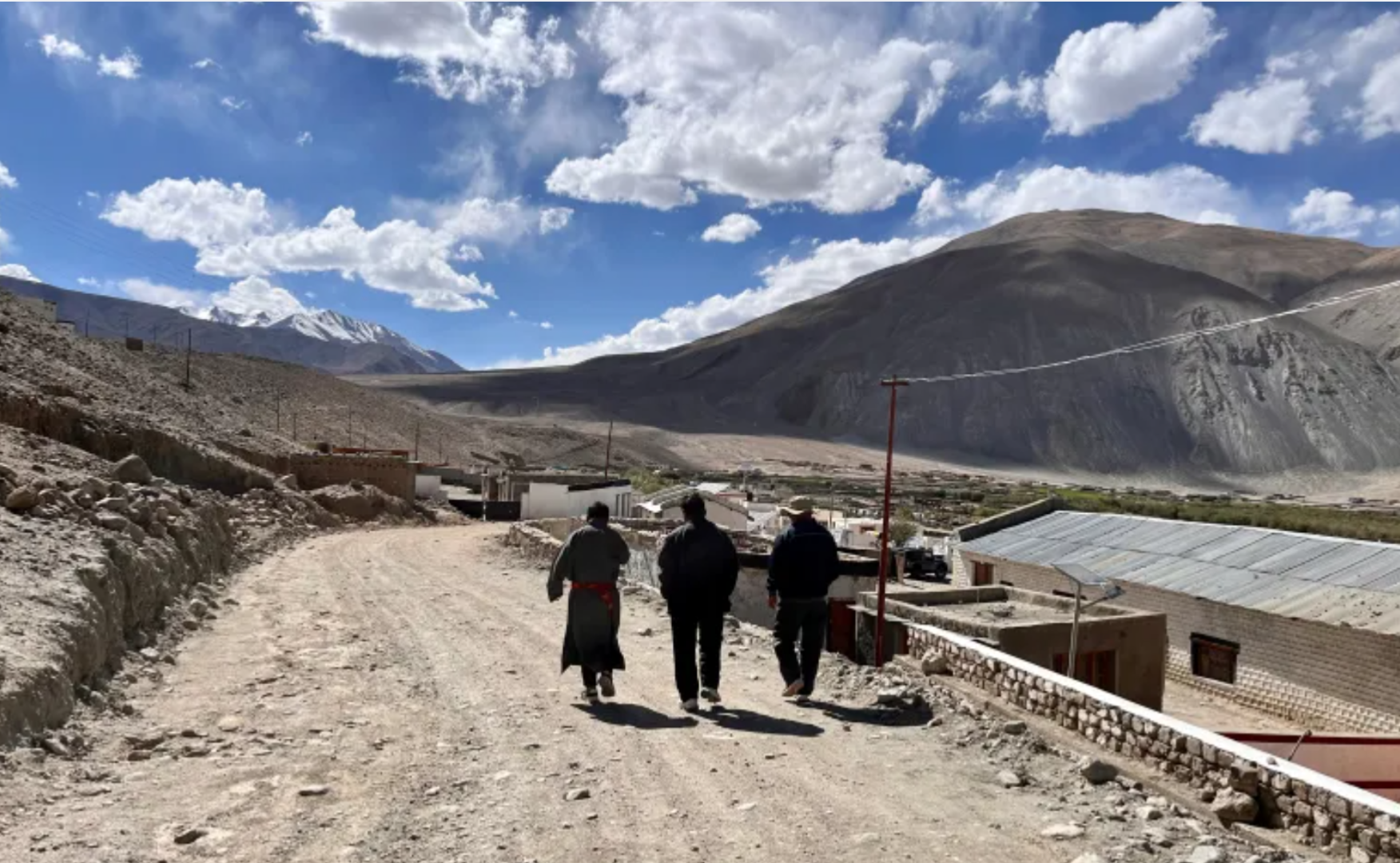
Seven years have passed since the monumental parliamentary decision on August 5, 2019, to abrogate Articles 370 and 35A, which irrevocably altered the semi-autonomous status of the former state of Jammu and Kashmir. This bold move fragmented the region into two separate Union Territories (UT) of Jammu and Kashmir and Ladakh – a shift that has left geopolitical scars along the northern frontier. What was initially perceived by New Delhi as a strategic masterstroke aimed at fostering greater integration has instead evolved into a complex and precarious equilibrium, marked by tension and uncertainty. Local residents are restless, and there is some concern in New Delhi, especially as this border state is under threat from China and Pakistan.
Ladakh’s trajectory changed after its separation from Jammu and Kashmir. In Buddhist-majority Leh and the strategic border areas, the 2019 UT status was initially welcomed as an end to decades of perceived neglect by Srinagar.
But residents realized that lack of statehood also meant losing land, job, and demographic protections previously available under Article 370. Direct rule from New Delhi, without legislative safeguards, triggered fears of cultural erosion, bureaucratic overreach, and corporate land grabs. Complete statehood includes having its own legislative assembly. When Ladakh became a Union Territory without a legislature, it lost the four elected MLAs who had represented the region in the erstwhile Jammu & Kashmir Assembly. The lack of direct legislative representation has left a political void and is seen by many residents as a key driver of the current discontent.
For Shia-majority Kargil, the reorganization was opposed from the start — seen as a downgrade to a UT without elected representation and a forced severance from Jammu and Kashmir. The discontent coalesced into two bodies: the Leh Apex Body (LAB) representing Leh, and the Kargil Democratic Alliance (KDA) representing Kargil. Formed after August 2019, both began agitating separately for statehood before joining hands in August 2021 to strengthen their leverage.
Despite deep historical and religious differences between Buddhist-majority Leh and Shia-majority Kargil, the LAB and KDA set aside their divide to forge a joint front. They united around a common four-point agenda — statehood for Ladakh, constitutional safeguards under the Sixth Schedule, which grants autonomous district councils with powers to make laws on land, forests and customary practice; separate Lok Sabha representation for Leh and Kargil; job reservations and a dedicated Public Service Commission for locals. This continues to form the core of the ongoing negotiations between the Ladakhis and the Ministry of Home Affairs (MHA).
The demand for statehood has been accompanied by protests, which culminated in violent clashes in September 2025 that led to civilian casualties and the invocation of the National Security Act (NSA) against prominent Ladakhi voices, including environmentalist and education reformer Sonam Wangchuk, who was put under preventive detention on September 26, 2025, and was subsequently held in Jodhpur Central Jail. The Ministry of Home Affairs officially revoked his detention and released him on March 14, 2026.
Against the backdrop of sustained local pressure and the strategic challenge of managing the Line of Actual Control (LAC) with China, particularly after the deadly 2020 Galwan Valley clashes, in 2021 the MHA opened high-level talks with Ladakh’s leadership. Instead of extending the Sixth Schedule, New Delhi has proposed an alternative model under Article 371 — similar to the special protections in place for Nagaland, Mizoram and Sikkim.
Statehood will give Ladakh full autonomy to govern the state, while as a UT it will be under direct control of New Delhi, as a hill regional council operates as a local governance body within the state or UT.
Meanwhile, New Delhi has begun mapping the region as a strategic, diplomatic, and cartographic countermeasure to assert its territorial sovereignty amid ongoing border standoffs with China. On October 2, 2026, the MHA, in coordination with the Survey of India and the Ladakh local administration, officially published a map establishing standardized names for 28 specific strategic locations and geographical features within the territory to streamline official cartography and improve public awareness (1). These 28 locations include 10 peaks and three mountains, two glaciers and two passes, seven land areas and one valley, one river, one lake and one water body.
The locations cover prominent border friction points along the LAC that were central to the 2020 military standoff – most notably Gogra and Hot Spring. It covers features in Aksai Chin (under Chinese control but claimed by India) and parts of Pakistan-administered Gilgit-Baltistan. This move is widely seen as a tit-for-tat cartographic response to Beijing, which, since 2017, has unilaterally issued multiple lists of altered Chinese names for places inside the Indian state of Arunachal Pradesh.
Two weeks later, on October 13, 2026, Chinese Foreign Ministry spokesperson Mao Ning strongly protested the move, declaring India’s standardized map “illegal, null, and void.” China explicitly stated it “has never recognised the so-called Union Territory of Ladakh unilaterally and illegally established by India” following the August 2019 bifurcation of Jammu and Kashmir. It asserted that India’s administrative mapping cannot alter the “objective fact” that the western section of the India-China border area belongs to China. New Delhi rejected these statements, asserting that Ladakh is an integral and inalienable part of India.
The statement was followed by yet another round of talks on Oct 15 between MHA and the Ladakh leadership, which again collapsed. The MHA provided a 32-page document to the Ladakh leadership, which envisages constitutional safeguards akin to Article 371, and gives 12 States special safeguards and administrative arrangements based on their distinct historical, cultural, and regional circumstances.
The government is now designing a new Constitutional provision for Ladakh in the form of Article 371 (K) that is expected to address some of the reservations and concerns unique to Ladakh. The latest proposal under Article 371, which the government presented to the Ladakhi leadership on October 17, seeks to strengthen the powers of Ladakh’s two Autonomous Hill Development Councils — Leh and Kargil — expanding their legislative, executive, and land-related authority, and introducing domicile-based protections for jobs and land. While seen as a step forward, civil society groups are insisting on substantive changes, which they say, will give them a greater say in how these safeguards are drafted and implemented.
For now, statehood is not on the agenda. In the meantime, in order to pacify the statehood demands, the government has taken some positive steps. On 19 October, the Chief Justice of India inaugurated the Ladakh Bench of the High Court of Jammu & Kashmir and Ladakh at Leh.[1]
On October 21, the UT administration dissolved the Kargil Hill Council, as panchayat elections will be held there on November 21 this year. The move, though small, does have consequences as Ladakhis await the next meeting with the MHA to discuss the draft proposal on Article 371(K).
For a region that guards India’s most hostile frontier, treating Ladakh as a bureaucratic division run from Delhi is short-sighted and can be strategically reckless. Ladakhis have proved their allegiance to India in every war, every winter, every standoff on the LAC.
And in a borderland that faces China every single day, alienation is a national security threat that no amount of troops can fix.
Nayanima Basu is the Adjunct Fellow at Gateway House and an author.
This article was exclusively written for Gateway House: Indian Council on Global Relations. You can read more exclusive content here.
For permission to republish, please contact outreach@gatewayhouse.in.
Support our work here.
© Copyright 2026 Gateway House: Indian Council on Global Relations. All rights reserved. Any unauthorised copying or reproduction is strictly prohibited.
References:
[1] Prior to this, on October 16, the Centre officially notified the creation of Sankoo as the eighth district of Ladakh, thereby separating it from Kargil district (3). Sankoo played a critical role by way of humanitarian and logistical hub during the 1999 Kargil War.
Administration of the Union Territory of Ladakh. “Chief Justice of India Inaugurates Ladakh Bench of the High Court of Jammu & Kashmir and Ladakh at Leh.” Press release, October 19, 2026. https://ladakh.gov.in/chief-justice-of-india-inaugurates-ladakh-bench-of-the-high-court-of-jammu-kashmir-and-ladakh-at-leh/.
Administration of the Union Territory of Ladakh. “Ladakh Administration Notifies Creation of Sankoo as New District of UT Ladakh.” Press release, October 16, 2026. https://ladakh.gov.in/ladakh-administration-notifies-creation-of-sankoo-as-new-district-of-ut-ladakh/.
Ministry of Home Affairs. “Government of India, in Consultation with UT of Ladakh, Identify 28 Places/Features, Located in the UT of Ladakh, by Standard Place and Feature Names on the Official Map of Survey of India (SoI).” Press Information Bureau, Government of India, October 2, 2026. https://www.pib.gov.in/PressReleasePage.aspx?PRID=2318027®=48&lang=2.