Viewed from the global, strategic, economic, Indo-Pacific, regional, or bilateral perspectives, the India-Republic of Korea (Korea) relationship has been gaining in importance, substance, and momentum. The ‘Special Strategic Partnership’ is now over a decade old, showing increased potential for its expansion and diversification. As vibrant democracies and leading global economies, the two nations have much more to contribute to the region and the world by deepening their cooperation in multiple domains.
The partnership has now deepened into a ‘Joint Strategic Vision’ during the April 19-21, 2026, state visit of Korean President Lee Jae Myung to India. Their historic joint statement from their visit, President Lee and Prime Minister Narendra Modi, demonstrates the way forward. Committed to enduring cooperation “in concrete ways”, to bring “lasting peace and progress to their peoples” in “a turbulent and fast-changing world”, the two leaders describe the partnership as a “Global Good.”
Much has already been achieved in diplomatic and political engagement and in securing increased convergence on strategic issues. New Delhi and Seoul share a vision of a free, open, peaceful, and prosperous Indo-Pacific region based on the rule of law, and Korea joining India’s Indo-Pacific Oceans Initiative (IPOI) is of significance in this context. The state visit was preceded by the Foreign Policy and Security Dialogue in February 2026, and the plan is to launch a 2+2 Dialogue involving the defence and foreign ministries as well as to begin the Joint Committee Meeting on Defence Industry Cooperation.
On economic cooperation, the launch of the India-ROK Economic Security Dialogue, which aims to enhance supply-chain resilience, promote market diversification, and advance cooperation in innovative technologies based on mutual strategic trust, has been especially welcomed by both governments.
Building on recent achievements, it is important to recognise the potential for much greater economic cooperation. Bilateral trade, at $25.6 billion in 2025, can easily double to $50 billion by 2030 – and that is the endeavour. Trade and investment are asymmetric, leaning in Korea’s favour. Korea’s cumulative investment in India since 1980 is $10 billion, as compared to $5.2 billion invested by major Indian corporations in Korea. There is immense scope to improve investment flows in both directions, especially as Korea is one of the global giants in Artificial Intelligence, both in factories and in education and research. This will build on the already strong base of Korea’s investment in auto parts, telecom, and mechanical appliances in India. Now is the time for the two countries to deepen their strategic engagement. The Indo-Pacific links connect the two nations better; hence, issues related to maritime security cooperation have gained greater significance.
Thus, focusing on the twin pillars of economic cooperation and maritime security, two scholars from Gateway House in Mumbai and two scholars from the Korean Institute for International Economic Policy and the Institute of Foreign Affairs and National Security, have crafted this compendium of papers on four carefully chosen themes.
The first paper, entitled India’s Emerging Developmental State: The Role of State-owned Infrastructure Development Financiers, by Dr Kyunghoon Kim, examines the role of financial institutions in the context of India’s accelerated infrastructure development since the mid-2010s. The author highlights the nature and role of two newer institutions – the National Bank for Financing Infrastructure and Development and the National Investment Infrastructure Fund. It expresses a considered view that these two institutions are excellent potential partners for Korea’s financial institutions.
The second paper, entitled Exploring a Role for the Republic of Korea in India’s Deep-Tech Startup Sector, by Amit Bhandari, examines opportunities in the tech startup and venture capital space.
Indian startups have grown well, but they have largely been confined to consumer-facing sectors such as e-commerce, fintech, and enterprise tech. Much more enticing opportunities exist in AI and semiconductors, which the Indian Government has identified as priorities. Korea is best positioned in this realm. The author recommends setting up dedicated hubs for Korean VC funds and startups to help channel Korean capital and expertise into India’s priority sectors.
The third paper, entitled Deepening the Republic of Korea-India Maritime Cooperation: Strategy and Key Priorities, by Dr Wondeuk Cho, highlights opportunities in the maritime sector, arguing that India’s planned shipbuilding clusters as well as naval modernisation plans offer immense possibilities for Korean firms in design, technology, maintenance and subsystems. Other potentially attractive areas include subsea cables, maritime and underwater domain awareness, autonomous and underwater vehicles, and other defence technologies. Collaboration between the two nations promises to be mutually beneficial.
The fourth paper, entitled Forging a Partnership Paradigm: India-Republic of Korea Maritime and Industrial Relations, by Lt Gen SL Narasimhan, projects the view that the increasing strategic importance of the Indian Ocean, especially in global trade, has created new opportunities and imperatives for deeper India-Korea maritime collaboration. The author suggests that industrial momentum may extend into security and governance cooperation across four pillars: Maritime Domain Awareness, joint exercises, multilateral groupings like IORA, IONS, and ASEAN forums, and third-country capacity-building endeavours involving the Maldives, Sri Lanka, and Mauritius.
Finally, one broad suggestion merits serious consideration. Given the long-term and strategic rationale for Korea-India cooperation for mutual benefit, the two nations must consider commencing a new, annual think tank-anchored dialogue between Gateway House and a suitable Korean counterpart. Thought leaders and domain experts, working together, will provide a blend of intellectual ballast and academic sustenance that is the need of the hour for this promising relationship.
As two leading members of the G20, India and Korea have a growing responsibility to help reshape the global order. India held the G20 presidency in 2022-23; Korea will shoulder this responsibility in 2027-28. As India’s External Affairs Minister S. Jaishankar stated in March 2024, the two nations will need “to identify more intersections and meeting points that work for both of us.” Acting in concert, they should be able to contemplate “the prospect of re-globalisation, shaped by emerging technologies”. In April 2026, Prime Minister Modi stressed that endeavours were underway to transform the bilateral relationship into “a futuristic partnership.” With powerful innovative ideas, political will, institutional support, and highly motivated knowledge partners to embrace, refine, and articulate the new vision, the two governments can turn it into reality.
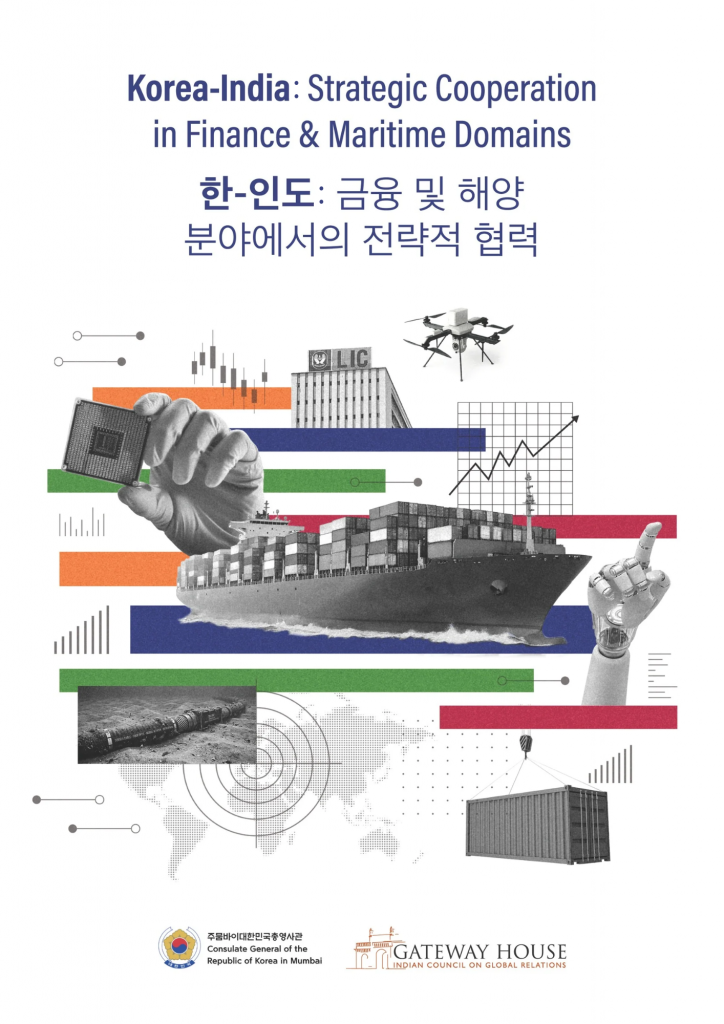
You can download the full paper here.
Dr Kyunghoon Kim is Head of the India and South Asia Team at the Korea Institute for International Economic Policy (KIEP).
Amit Bhandari is the Senior Fellow for Energy, Investment and Connectivity at Gateway House.
Dr Wondeuk Cho is Director of the Center for ASEAN-Indian Studies.
Lt Gen S. L. Narasimhan is the Distinguished Fellow for National Security and China Studies at Gateway House.
Support our work here.
For interview requests or for permission to republish, please contact website@gatewayhouse.in.