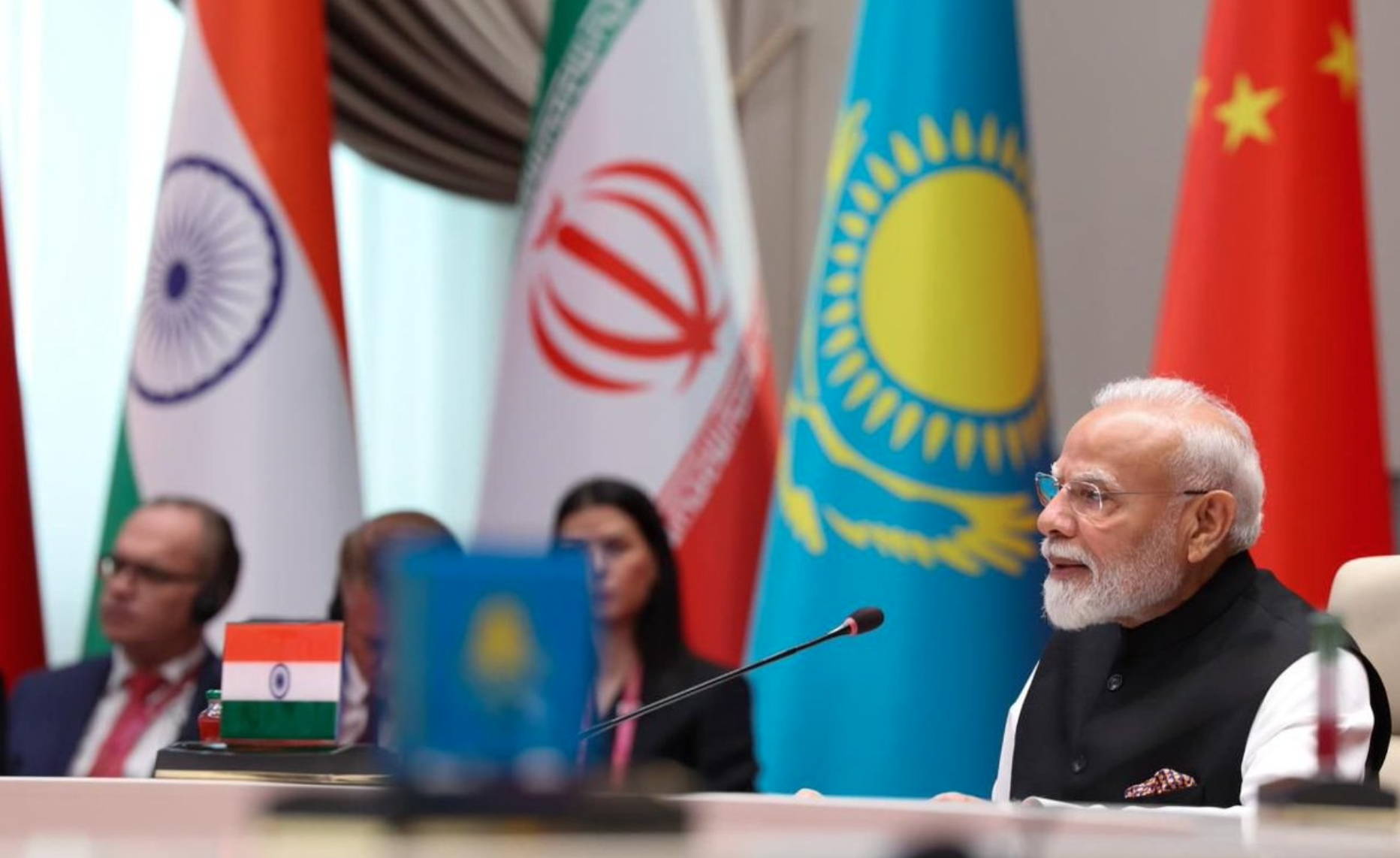
Prime Minister Narendra Modi’s participation in the annual summit of the Shanghai Cooperation Organisation (SCO) in Bishkek, Kyrgyzstan, held in commemoration of the 25th anniversary of this influential coalition of Eurasian nations, was a significant display of India’s commitment to upholding its strategic autonomy on the global stage. This gathering offered a vital opportunity for Modi to reconnect with his regional allies, especially in the light of the ongoing tensions resulting from the war in the Gulf which have profoundly disrupted the stability of the global economy.
The Bishkek Declaration emerged as a pivotal statement, denouncing the military interventions by the U.S. and Israel (without naming the two countries) against Iran while simultaneously voicing solidarity with Tehran’s aspirations for peaceful nuclear technology under the framework of the Nuclear Non-Proliferation Treaty (NPT). This sentiment is sure to provoke unease in Washington, as the declaration explicitly articulated a strong position against military aggression.
Additionally, the document extended formal condolences for the assassination of Iranian Supreme Leader Ali Khamenei, who was killed in a targeted airstrike in February 2026, marking a singular moment in the region’s tumultuous landscape.
India’s signing on to the statement signals that New Delhi is once again emphasising its foreign policy principle of strategic balancing. India has begun to put a greater focus and gravitas on the China-led SCO, even as its bilateral relationship with the U.S. continues to be strained, with the Donald Trump administration pinning India down with continuous tariff increases. That has led to the slowdown of negotiations on the important India-U.S. Bilateral Trade Agreement (BTA).[1]
The new leaning toward Eurasia is a change from just six years ago. Then, tensions between India and China increased due to the 2020 military clash in Galwan Valley, and New Delhi began aligning more with the West while distancing itself from regional groupings like the SCO and BRICS. In 2022, during Uzbekistan’s chairmanship of the SCO, PM Modi chose to skip the pre-summit informal dinner in Samarkand to maintain a diplomatic distance from Chinese President Xi Jinping and Pakistani Prime Minister Shehbaz Sharif. India aimed to avoid any false impressions of normalcy through informal gatherings or group photos.
In 2023, despite being the chair of the SCO for the first time since India became a full-time member in 2017, the Modi government chose to host the SCO Summit virtually[2] in order to avoid sharing a common platform with Xi.[3]
In 2024, India chose to dispatch External Affairs Minister S. Jaishankar to attend the SCO Summit in Astana, Kazakhstan. PM Modi skipped that meeting due to several factors, one being India’s growing alliance with the U.S. and greater focus on the Quad and Indo-Pacific, then also high on Washington’s foreign policy agenda.
Witnessing India’s changing stance, many Central Asian countries expressed their concerns, suggesting that India had neglected the SCO in favour of a greater engagement with the U.S. and the European Union. The shift in focus led to discontent among these nations, who felt sidelined by India’s changing diplomatic priorities.
These were interpreted as strategic moves aimed at distancing India from any anti-U.S. rhetoric or resolutions that emerged from the discussions within the organisation. It underscored India’s careful navigation of international relationships, balancing its commitment to regional alliances while also aligning itself more closely with Western powers.
However, this dynamic changed in 2025 when Modi travelled to the Tianjin summit in China for the 2025 SCO summit, and also for the recently concluded 2026 Bishkek summit on August 31-September 1. The signal was clear: India was back, with an active, in-person engagement with Eurasia.
India signed and fully endorsed the Bishkek Declaration, which represented a shift in its public diplomatic stance regarding the conflict in Iran. Previously, India walked a fine line to protect its deep defence and strategic ties with Israel and the U.S. For instance, New Delhi had distanced itself from an SCO defence ministers’ statement in June 2025 that explicitly condemned Israeli strikes, clarifying that it did not take part in the discussions leading to the statement and that it did not reflect India’s position.[3]
In Bishkek, PM Modi had a bilateral meeting with Russian President Vladimir Putin on the sidelines of the SCO Summit as well as with Iranian President Masoud Pezeshkian. In both cases he urged dialogue and diplomacy in ending the wars their respective countries are fighting. The U.S. has not yet reacted to the SCO meeting, unlike last time when U.S. President Trump expressed indignation at seeing the Russian, Chinese and Indian leaders sharing a light moment in Tianjin in September 2025.
However, India’s real challenge now lies in carrying forward this delicate balance and developing a strong agenda for the upcoming BRICS Summit and aiming for a comprehensive joint statement. Four SCO countries – India, China, Russia and Iran – are also members of the BRICS. Therefore, like the SCO, the upcoming BRICS Summit will surely be watched closely by the U.S.
India, along with its BRICS partners, has worked diligently towards the group’s expansion while maintaining a regional focus and preventing it from becoming an “anti-West” platform. Unlike China and Russia, which have suggested a shared currency to bypass the U.S. dollar, India has firmly opposed the idea of a common BRICS currency. Drawing on the success of the recent SCO Summit, India has the potential to build on this momentum and successfully walk the tightrope between east and west.
Nayanima Basu is the Adjunct Fellow at Gateway House and an author.
This article was exclusively written for Gateway House: Indian Council on Global Relations. You can read more exclusive content here.
For permission to republish, please contact outreach@gatewayhouse.in.
Support our work here.
© Copyright 2026 Gateway House: Indian Council on Global Relations. All rights reserved. Any unauthorised copying or reproduction is strictly prohibited.
References:
[1] Nayanima Basu, “New Tariffs Complicate India-U.S. Trade Negotiations,” Gateway House: Indian Council on Global Relations, August 27, 2026, https://www.gatewayhouse.in/new-tariffs-complicate-india-u-s-trade-negotiations/.
[2] During both times the government pointed out to “scheduling difficulties”.
[3] “SCO Summit under India’s Chairmanship,” Ministry of External Affairs, Government of India, May 30, 2023, https://www.mea.gov.in/press-releases?dtl/36622/SCO_Summit_under_Indias_Chairmanship.
[4] “Statement on the Shanghai Cooperation Organization (SCO),” Ministry of External Affairs, Government of India, June 14, 2025, https://www.mea.gov.in/speeches-statements?dtl/39670/Statement+on+the+Shanghai+Cooperation+Organization+SCO.