In recent years, the Indian Navy has solidified its role as a “net security provider and “first responder” in the Indo-Pacific, particularly in the Indian Ocean Region (IOR). This evolution is driven by its mission-based deployments, which ensure a continuous presence across critical sea lanes to safeguard national and international maritime interests. The Indian Navy’s recently concluded maritime trifecta in Visakhapatnam sent a strong message to the world of not only the force’s growing prowess but also the indispensable role played by India in maritime military diplomacy.
The ceremonial “crown jewel” of the trifecta was the International Fleet Review (IFR) 2026 that showcased global naval solidarity and India’s indigenous maritime strength. On display was a massive assembly of over 75 ships and 60 aircraft. Naval delegations and vessels from over 70 nations participated, including naval assets from the UAE and Philippines which came for the first time. Navies from the U.S., Russia, Iran, Bangladesh and Myanmar, among others were part of the trifecta.
The IFR, is a ceremonial assembly of ships, submarines and aircraft from multiple countries, was held in Bay of Bengal on February 18, off the coast of Visakhapatnam. It is reviewed by the President of the host nation, and this year it was President Droupadi Murmu who stood on board the INS Sumedha, an indigenously built Naval Offshore Patrol Vessel, that served as the Presidential Yacht.
The event featured both anchored and mobile columns of warships and submarines, accompanied by a fly-past of naval aircraft. Some of the key highlights included a parade of sailing vessels, search and rescue demonstrations and special operations boat displays by Marine Commandos – a compelling showcase of naval capability and coordination.
This IFR has taken place after a decade, as is its usual practice. The first international review was held in Mumbai in 2001 to mark the 50th anniversary of the Indian Republic. The second IFR was organised in Visakhapatnam in 2016. The 2026 IFR was also in Visakhapatnam, this time coinciding with the 75th anniversary of the Indian Republic and to highlight India’s role as a “Preferred Security Partner” in the region.
This year the review featured 85 ships in total, including 19 foreign warships. Among the high-profile visiting vessels were the Russian Udaloy-class destroyer Marshal Shaposhnikov, the Australian frigate HMAS Warramunga, and the Iranian destroyer IRINS Dena. All 10 ASEAN member states were invited, with active participation from Indonesia, Malaysia, Philippines (maiden asset participant), Singapore, Thailand, Vietnam, and Myanmar. All four Quadrilateral Security Dialogue partners (India, U.S., Japan, and Australia) were also present.
The diverse gathering was held under the theme ‘United Through Oceans.’ It promoted and operationalised India’s MAHASAGAR vision for collective maritime security. It is an extension of the Narendra Modi government’s SAGAR (Security and Growth for All in the Region) vision, which was launched in 2015 to emphasise India’s maritime domain awareness and security in the seas. It was extended to MAHASAGAR (Mutual and Holistic Advancement for Security and Growth Across Regions) in 2025 to expand India’s influence in the Global South thereby asserting the role of a regional leader and to also, ostensibly, restrict China’s growing presence in the Indo-Pacific and Indian Ocean Region.
“China’s Belt and Road Initiative along with the String of Pearls strategy and its proximity with Pakistan, have deepened Beijing’s penetration into the Indian Ocean. MAHASAGAR reinforces India’s partnerships with smaller island states like Mauritius so that they do not drift away from Indian interests. The agreements on currency trade and economic cooperation among these countries diminish external economic influence, thereby increasing regional economic independence,” according to a report by the Indo-Pacific Studies Center, an Australia-based think tank.[1]
The report also said, “Another crucial aspect is strengthening maritime security. The increasing Indian naval exercises, information-sharing, defence collabs, and surveillance of the Indian Ocean increases its security against piracy, illegal fishing, military expansion, and other threats. As a result, MAHASAGAR strengthens India’s regional security role and increases its presence in strategically important waters.”
This collaboration is much needed in the region. China’s presence in the Indo-Pacific has reached a record-high operational tempo, shifting from only regional assertiveness to that of increased air and maritime activities which have threatened the security of the seas around the Taiwan Strait, South China Sea near Japan, and beyond the First Island Chain.[2]
In 2025, the People’s Liberation Army conducted 3,764 air incursions into Taiwan’s ADIZ, a 22% increase over the previous year, and a record 163 naval operations, establishing a permanently elevated new normal for military pressure. The focus has shifted toward the Scarborough Shoal, where the presence of the China Coast Guard has more than doubled.
India is countering Chinese influence through the MAHASAGAR vision by strengthening its own naval outposts in the Andaman and Nicobar Islands, but the Indian Navy itself is lagging behind the Chinese PLA Navy and the gap is widening, despite India’s record-breaking induction pace of one warship every six weeks. This is unprecedented expansion. India will induct 19 vessels in 2026, up from 14 in 2025. It follows the induction, in 2025, of major combatants, submarines and specialised coastal vessels. In January 2025, in a first, three frontline platforms were launched – INS Nilgiri, a stealth frigate, INS Vagsheer, a Scorpene-class submarine and INS Surat, a guided-missile destroyer.
While India maintains a home advantage in the Indian Ocean, several structural and technological lags persist. Despite a record induction of warships in 2025, the Indian Navy continues to face several critical shortcomings that impact its overall combat effectiveness and long-term strategic goals. Most of India’s conventional submarines are over 30 years old, such as the Kilo and Shishumar class ones. While the Navy previously sought a 24-submarine fleet, bureaucratic delays have left it with roughly 16 operational conventional boats.
Additionally, India’s current fleet of submarines lacks Air-Independent Propulsion, a technology that allows submarines to stay submerged at length. There is a notable absence of new destroyers or conventional submarines currently under construction following the completion of the Kalvari (Scorpene) class.
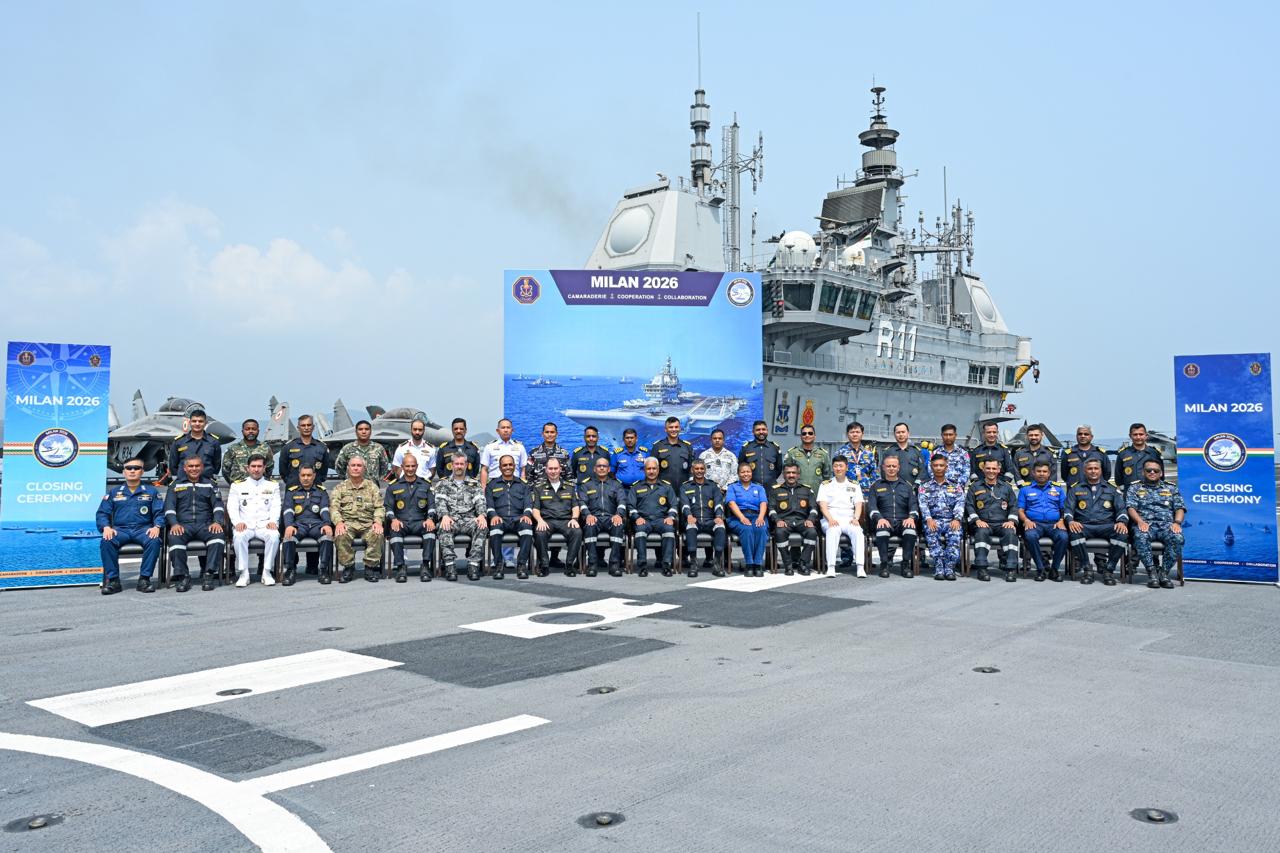
In order to match the naval capabilities of its adversaries – specifically China and Pakistan – the Indian Navy can opt for a multi-pronged strategy of focusing on establishing and expanding strategic alliances through gatherings like MILAN that enable enhanced interoperability, and double down on indigenous expansion.
Nayanima Basu is Adjunct Fellow, and an author.
This article was exclusively written for Gateway House: Indian Council on Global Relations. You can read more exclusive content here.
For permission to republish, please contact outreach@gatewayhouse.in.
Support our work here.
©Copyright 2026 Gateway House: Indian Council on Global Relations. All rights reserved. Any unauthorised copying or reproduction is strictly prohibited.
[1] Indo-Pacific Studies Center. “India Mahasagar Initiative.”
https://www.indo-pacificstudiescenter.org/commentaries/india-mahasagar-initiative
[2] Center for Strategic and International Studies (CSIS). “China’s Increased Military Activities in the Indo-Pacific, 2025.” ChinaPower Project. https://chinapower.csis.org/china-increased-military-activities-indo-pacific-2025/