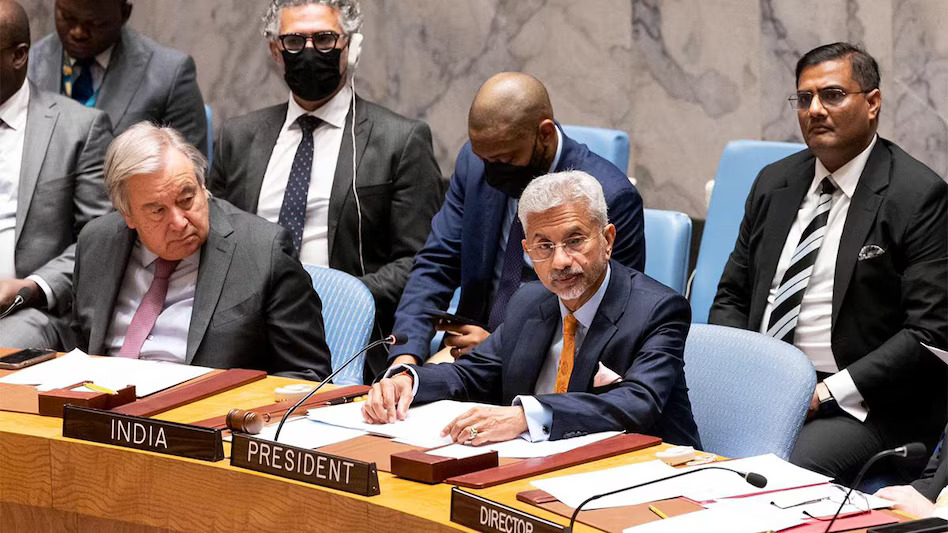
On July 13, External Affairs Minister S. Jaishankar launched India’s official campaign for a non-permanent seat on the UNSC for 2028-29. The elections will be held in June 2027, and India’s competitor for the Asia-Pacific seat is Tajikistan If elected, this will be India’s ninth time on the UNSC.
The UNSC is today the UN’s most significant limb wherein its members, in particular the P5—the U.S., UK, France, Russia, and China—preside over the maintenance of global peace and security. At the moment, two of the P-5, instead of being neutral, are themselves involved in the two bitter wars ongoing in the Gulf and in Ukraine
Unlike the actions of the P-5, including exercising vetos, the elections are process-driven and strict. The UNSC has 15 members, of which five are permanent and 10 are non-permanent members, which are elected for two-year terms by the General Assembly. These non-permanent numbers rotate between the 193 countries that comprise the membership of the UN. In its 80-year existence, however, 143 countries have led the UNSC, leaving out a fourth of the grouping.
Of the UNSC’s 10 elected members, three from Africa, two each from Asia, Latin America, and Western Europe, and one from Eastern Europe. European representation reflects a certain reality following WWII. Five elected members retire every year, making way for a rotation among the non-permanent members. Pakistan is presently on the UNSC from Asia, serving the 2025-26 term, while Bahrain is there till 2027. Kyrgyzstan will replace Pakistan in 2027 and serve through 2028.
Unlike UN resolutions where a country’s vote is publicly displayed, a blank sheet is the ballot paper for the UNSC. Voters are supposed to know who is running, and write-in the name of the country of their choice on the ballot
Viewed from an outsider’s perspective, India’s challenge against Tajikistan should hardly be a contest given India’s global standing, G20 membership, etc. But elections at the UN follow their own convoluted logic, as was seen in June this year. In a three-way contest for two seats among the western countries, Portugal and Austria pipped heavyweight Germany. The election being a secret ballot, it is hard to be definitive, but it appears that in the global South there is a certain unhappiness with Germany’s support for Israel on Gaza. There is also the issue of smaller countries’ bonding in solidarity with other smaller countries against global heavy weights.
As large financial contributors to the UN and aspirants for permanent membership of the UNSC, the Germans have sought to get elected to the UNSC every seventh or eighth year (they last served the 2019-20 term). This is also the case with Japan. The German loss appears to be now prompting the Japanese to relook at a proposed bid for the UNSC in 2032 and instead revert to looking ahead to 2043, which would be their turn by rotation in the 54-member Asian group.
At the same time, in the Asian group, Kyrgyzstan soundly defeated the Philippines, a country that has long been around at the UN and had ASEAN backing. The reason? The 50-plus-member Organisation of Islamic Countries (OIC) group and strong Chinese backing not just tilted the scales but did so to such an extent that the Kyrgyz obtained as many as 142 votes out of 191 cast and comfortably crossed the two-thirds requirement of 127 votes.
There was also a contest for the UNGA Presidency this time in which the Foreign Minister of Bangladesh got the better of the candidate from Cyprus. Here too it would appear that factors which are similar to what benefited Kyrgyzstan and saw the defeat of Germany were in operation.
These factors obviously add to the needs for a robust and across-the-globe campaign by India. Rightly, therefore, the Indian campaign has been launched well in time not only to ensure the election but with the highest possible number of votes to signal global acceptance of India, now the world’s most populous country, as a permanent member of the UNSC.
The situation for India in 2027 is not dissimilar to 2010, when India contested for the UNSC. Then, Kazakhstan was in the fray too. Active diplomacy in New York and across the world coupled with strong efforts on the bilateral front saw the Kazaks repositioning their candidature to 2017-18, leaving India as the sole candidate in 2010. India was elected with 187 votes from 192 cast – a record. Such a global endorsement continues to remain important for India as it seeks a permanent place on the high table of the UNSC.
Ambassador Manjeev Puri is an Adjunct Distinguished Fellow and a former diplomat who served in the UN, EU and Nepal as Ambassador.
This article was exclusively written for Gateway House: Indian Council on Global Relations. You can read more exclusive content here.
Support our work here.
For permission to republish, please contact outreach@gatewayhouse.in
© Copyright 2026 Gateway House: Indian Council on Global Relations. All rights reserved. Any unauthorised copying or reproduction is strictly prohibited.