On January 20, 2026, Canadian Prime Minister Mark Carney made a speech at the World Economic Forum in Davos, where he frankly admitted that the rules-based international order was “partially false” and put forth an alternative of “collective investments in resilience.” One of those investments, he said, was Canada’s reinforced, “unwavering” commitment to Article 5 of NATO, over the demand for Greenland by the U.S.[1] Article 5 states that “an armed attack against one NATO member shall be considered an attack against them all” The U.S.’s stated desire to take control of Greenland, an autonomous territory of NATO member Denmark, has broken that article of Transatlantic faith.
It has alarmed the 31 other members of NATO and driven a surge of analyses by experts on what it indicates. For instance, Elina Ribakova, non-resident Senior Fellow at the Peterson Institute in Washington, D.C., described it as The New Economics of War in her December 6, 2025, essay in the Financial Times. The Russia-Ukraine war, she says, has defied existing views on the economics of war that size and industrial capacity of a country are a guarantee for victory. Instead, she says, mobilisation, logistics and adaptability seem to be the new factors for winning wars, and that even if the U.S. decides against supporting Ukraine, European financing and Ukrainian ingenuity can build a deterrent against external threats. In which case, “NATO’s Article 5 would no longer serve as the alliance’s primary foundation.”
But can NATO survive without Article 5? And can Article 5 survive without the U.S. defence cover for Europe?
NATO was formed in 1949 with the aim of a collective security for Europe against the Soviet threat. The agreement, initially signed by 12 nations including Belgium, Canada, Denmark, France, Iceland, Italy, Luxembourg, the Netherlands, Norway, Portugal, the UK, and the U.S., sought to defend Europe through Article 5 of the Treaty.
The Article 5 of the Treaty states, “The Parties agree that an armed attack against one or more of them in Europe or North America shall be considered an attack against them all, and consequently they agree that, if such an armed attack occurs, each of them, in exercise of the right of individual or collective self-defence recognised by Article 51[2] of the Charter of the United Nations, will assist the Party or Parties so attacked by taking forthwith, individually and in concert with the other Parties, such action as it deems necessary, including the use of armed force, to restore and maintain the security of the North Atlantic area. Any such armed attack and all measures taken as a result thereof shall immediately be reported to the Security Council. Such measures shall be terminated when the Security Council has taken the measures necessary to restore and maintain international peace and security.”
Seventy-seven years after this statement was penned, it is clear that the UN Security Council is incapable of drawing any kind of peace from the Russia-Ukraine conflict.
The weight of Article 5 clearly lies in the U.S. supporting any of its European allies if under attack. European countries have therefore reduced their investments in defence capabilities, leaving it to the U.S. to contribute disproportionately: approximately two-thirds of the NATO budget and 40,000 troops. As recently as last year, the Pentagon requested $2.9 billion for fiscal year 2025[3] for the European Deterrence Initiative or (EDI) which involves rotational forces (maintaining continuous U.S. presence through air, land and sea), prepositioning of equipment, ammunition and fuel, upgrading military facilities in Europe and for exercises and training.
The graph below shows the contribution of the U.S. and Europe plus Canada, where the U.S. still carries NATO’s responsibility more than all other countries combined.
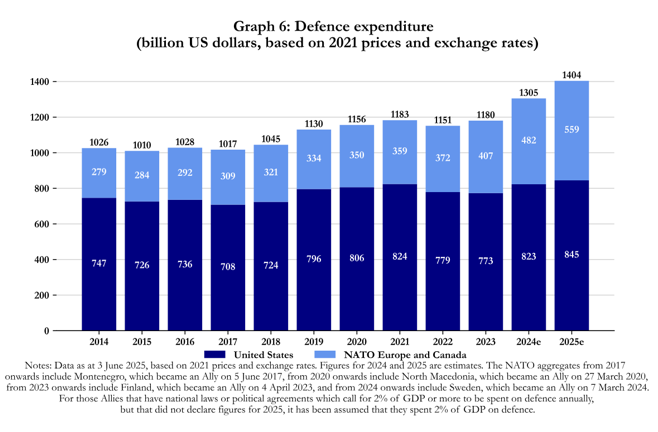
Source: Defence Expenditure of NATO Countries (2014-2025)[4]
Can Europe indeed operate without Article 5, and fully support Ukraine in its war against Russia? Since January 2022, the U.S. has given $175 billion[5] in assistance to Ukraine and the EU has contributed $197 billion.[6] Of the $175 billion contributed by the U.S., $71 billion[7] was for arms and equipment. The U.S. has supplied[8] 8.2% of the tanks, 24% of infantry fighting vehicles, 41% of the Howitzers, 49% of high mobility artillery rocket systems and 22% of air defence systems. Overall, the U.S. has provided the largest funding to Ukraine in the Russia-Ukraine war. It is therefore not correct to state that Ukraine has sustained its war effort through mobilisation, logistics and adaptability.
To go it alone, Europe would have to replace the military equipment supplied by the U.S. – a significant hurdle, given that many European states are already facing shortages of such materiel. Recently, they have committed only 5% of their GDP for defence, and sustaining increasing funding for Ukraine will be a long path.
Should Europe decide to dilute Article 5 and keep the U.S. out, these countries will still have to face the additional tariffs that the U.S. has threatened to impose on them if they do not support the U.S. proposed purchase of Greenland – a further complication.
To be fair to Europe, it has embarked on a European Defence Industry Programme[9] with 65% parts to be sourced from EU countries with a grant of Euros 1.5 billion for 2025-27. This was adopted by the European Council on December 8, 2025. However, for Europe to become self-sufficient it will take some time, money and effort.
Equipment apart, Europe faces a societal issue on this front. Without the U.S, providing troops to NATO, replacements will have to come from within Europe. A 2024 Gallup Poll revealed that the majority population in European countries are unwilling to take up arms for their own countries, should they come under attack. How then, will Europe defend itself – or Ukraine?

Source: Gallup International[10]
Russia has not deployed the full range of its most modern weapons against Ukraine. Should it do so, then Ukraine and Europe will come under pressure. If Europe was able to help Ukraine fully to fight the war, then Ukraine would not be making frequent requests to Washington for assistance. Wars are fought not just on mobilisation, logistics and adaptability. These factors are part of any war. Ukraine has sustained itself through its ordeal with its troops fighting with their backs to the wall but with patriotism and the support of both the U.S. and Europe.
It will be difficult for NATO to defend itself without the U.S., and the U.S. will find it difficult to keep its influence over Europe without Article 5. To have some defence independence, the European countries will have to seriously concentrate on building their military capabilities, individually and collectively.
Lt Gen S L Narasimhan is the Adjunct Distinguished Fellow for China and National Security Studies at Gateway House.
This article was exclusively written for Gateway House: Indian Council on Global Relations. You can read more exclusive content here.
For permission to republish, please contact outreach@gatewayhouse.in.
Support our work here.
© Copyright 2026 Gateway House: Indian Council on Global Relations. All rights reserved. Any unauthorised copying or reproduction is strictly prohibited.
References:
[1] North Atlantic Treaty Organization (NATO). “Collective Defence and Article 5.” NATO. https://www.nato.int/en/what-we-do/introduction-to-nato/collective-defence-and-article-5
[2] United Nations Security Council. Repertoire of the Practice of the Security Council: Actions. https://main.un.org/securitycouncil/en/content/repertoire/actions
[3] U.S. Department of Defense, Office of the Under Secretary of Defense (Comptroller). FY 2025 Budget Request: EDI Book. Washington, DC: U.S. Government, 2024. https://comptroller.war.gov/Portals/45/Documents/defbudget/FY2025/FY2025_EDI_JBook.pdf
[4] North Atlantic Treaty Organization (NATO). Defence Expenditure of NATO Countries (2025 Edition). Brussels: NATO, 2025. https://www.nato.int/content/dam/nato/webready/documents/finance/def-exp-2025-en.pdf
[5] Ukraine Oversight. Funding. https://www.ukraineoversight.gov/Funding/
[6] European External Action Service (EEAS). “EU Assistance for Ukraine — US Dollars.” EU Delegation to the United States. https://www.eeas.europa.eu/delegations/united-states-america/eu-assistance-ukraine-us-dollars_en
[7] Council on Foreign Relations (CFR). “How Much U.S. Aid Is Going to Ukraine.” https://www.cfr.org/article/how-much-us-aid-going-ukraine
[8] “Tracking U.S. and NATO Support for Ukraine: A Full Breakdown.” https://www.aljazeera.com/news/2025/8/21/tracking-us-and-nato-support-for-ukraine-a-full-breakdown
[9] Council of the European Union. “Defence Industry Programme (EDIP).” European Council. https://www.consilium.europa.eu/en/policies/defence-industry-programme/#edip
[10] Gallup International. Fewer People Are Willing to Fight for Their Country Compared to Ten Years Ago. 2024 Survey Report. https://www.gallupinternational.com/fileadmin/user_upload/surveys_and_news/2024/Fewer_people_are_willing_to_fight_for_their_country_compared_to_ten_years_ago/Fighting_for_the_country.pdf