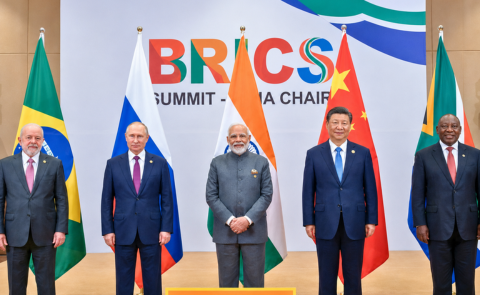
India hosts the 18th BRICS summit, a major plurilateral grouping of the 21st century, amid adverse geopolitical circumstances. Russia, a leading member, remains involved in its war against Ukraine, which began out in February 2022. Three of its members – Iran, the UAE and Saudi Arabia (which mostly absent itself from meetings or observes silence) – have been engaged in the U.S.-Israel war against Iran. The U.S., the lone superpower with an expressed anti-BRICS sentiment, has issued an unmistakable threat to all states to cut off economic relations with Iran or be prepared to face consequences. The UN and other multilateral organisations have lost much of their relevance and are unable to bring working peace to the ongoing conflagrations.
What then can the BRICS hope to achieve when they meet September 12-13 on Indian soil to advance the cause of world peace, development, a fair international order, and a better deal for the Global South?
Despite the challenges, the members of the BRICS family – 11 member states and 10 partner states – do believe in “the BRICS spirit” and its mission to improve the world by raising their voices on critical issues and by deepening their strategic partnership as a bulwark against future shocks. Hence, it is essential to track the BRICS trajectory through its last three summits to obtain a clear idea of what might emerge at the Delhi summit.
The first decade of the BRICS’ journey (2006-16) was full of promises and achievements. A grouping of merely five nations asserted itself quite well as the economic and political heft of its member states rose and as they created significant mechanisms such as the New Development Bank (NDB) and the Contingent Reserve Arrangement (CRA). A major contribution was the reform agenda covering the UN and its Security Council as well as the international financial architecture and quota increase in the IMF and World Bank for developing countries. This helped BRICS emerge as a counterpoint to the G7 and a sheet anchor for the developing world within the G20.[1]
The second decade (2017-2026), however, was marred by the Covid pandemic and online summits in 2020, 2021, and 2022. While this denied the leaders the opportunity for personal interaction, BRICS still managed to project its solidarity and seriousness of purpose, prompting over 30 nations to seek membership.
The 15th Johannesburg Summit took place in this backdrop in August 2023. It projected the grouping as a partnership for “inclusive multilateralism” and for “mutually accelerated growth”, committed to fostering a global environment of peace and development. It also reaffirmed its call for the implementation of the 2030 Agenda for Sustainable Development in its three dimensions – economic, social and environmental.[2] The intra-BRICS cooperation project on the New Industrial Revolution (PartNIR), first established at the 2018 Johannesburg Summit,[3] for creating and accelerating new opportunities in industrial development,[4] was carried forward. On institutional development, the member states reached consensus on “the guiding principles, standards, criteria, and procedures of the BRICS’ expansion”. The endeavour was to create an objective basis for accepting new members.
A significant decision was taken in Johannesburg – to expand the grouping. Six states, namely Argentina, Egypt, Ethiopia, Iran, Saudi Arabia, and the UAE, were invited to become full members of BRICS. Eventually, Argentina declined, while Saudi Arabia maintained ambiguity but was still accepted as a member. Ethiopia was admitted even though it did not meet the criteria. Later, Indonesia was added, thus taking the membership to 11.
The 16th Kazan summit was held in October 2024 amid rising enthusiasm for BRICS in the developing world. It began by extolling the virtues of multipolarity and multilateralism. While the former would expand opportunities for the Emerging Markets and Developing Countries (EMDCs) and the Least Developed Countries (LDCs), the latter was an article of faith with the leaders, stressing their commitment to “a more agile, effective, efficient, responsive, representative, legitimate, democratic, and accountable, international and multilateral system.” Reform of the UN, including the Security Council; the strengthening of the international trading system “with the World Trade Organization (WTO) at its core”; and progress towards Sustainable Development in accordance with the tenets of the United Nations Framework Convention on Climate Change (UNFCCC) were presented as the key components of the desired international order.[5]
Stress was also laid on fostering economic and financial cooperation for “just global development”. In particular, the finance ministers and central bank governors were tasked to continue their consideration of “the issue of local currencies, payment instruments, and platforms”. The list of BRICS partner states was also finalised at this summit.
Brazil hosted the 17th summit in Rio de Janeiro in October 2025. In a 126-paragraph declaration, all the key themes and proposals of BRICS were elaborated, with varying emphasis. The summit also saw the inaugural meeting of the new partner states. Deep concern was expressed about the “ongoing conflicts in many parts of the world”, which reduced development spending in favour of military expansion. The grouping condemned the U.S.-Israeli military strikes against a fellow member – Iran – as well as coercive economic measures taken against Iran by the Western powers.[6]
This led the BRICS to seriously take steps to deepen trade and financial cooperation within the BRICS family. This was laid down in the “Strategy for BRICS Economic Cooperation 2025″, which set out a roadmap for three priority areas: trade, investment and finance; digital economy; and sustainable development. It also committed member states to respect each other’s economic sovereignty and pursuit of cooperation through consensus.[7] BRICS as a workable alternative to the existing order was beginning to be well accepted, and in 2024, 30 countries were in the queue to join the grouping, according to the Russian president.[8][9]
Against this backdrop, the 18th summit in Delhi takes place amidst intense international diplomatic activity. It was preceded by the SCO summit in Bishkek (August 3-September 1) and the G20 finance ministers and central bank governors meeting in Asheville, North Carolina, U.S. (August 31-September 1), and will be followed by President Xi Jinping’s official visit to the U.S., possibly from September 23-25.
The Delhi Summit, therefore, will take into account the global view, with five critical dimensions.
First, India as a host nation is eager for the top leaders of the five founding members of BRICS to be present in Delhi as well as a majority of the top leaders of the other member and partner states. This will give visible heft to the summit. This will provide diplomatic ballast, producing a consensus-based Delhi Declaration, full of meaning and substance. This was the task that the foreign ministers failed to complete at their meeting in May 2026.
Second, the war in Iran has created unprecedented pressure on the BRICS. With a mixture of anti-Western or non-Western perspectives, the grouping found it easy to take positions in the past that were antithetical to the U.S. Not anymore, particularly with the Trump administration. On the U.S.-Israeli war against Iran, BRICS needs to take a position that satisfies all sides. It may criticise both the invasion of Iran and the Iranian counterattacks, without naming the countries concerned, while calling for an early, holistic and peaceful settlement and stressing the need to keep international waterways open for commerce and to ensure the safety of seafarers.
The ASEAN Foreign Ministers’ Statement of 4 March 2026[10] offers an example. ASEAN’s statement reiterated the dangers to “regional and global peace and stability”, reflecting the grouping’s broader vulnerability to the conflict. Washington’s threat to all nations to cut economic ties with Iran or face secondary U.S. sanctions must be addressed with a blend of firmness and resilience. On these other sensitive matters, the Sherpas have been busy and are currently engaged in “candid conversations” that could yield formulations acceptable to all and introduce some positivity into the discussions.
Third, at the heart of the BRICS agenda – UN reform, reform of international financial governance architecture, advancing Sustainable Development Goals 2030, strengthening of the WTO, and the call for more financing for the development of developing countries – there is little realistic possibility of meaningful progress. However, that will not prevent the grouping from reiterating its traditional positions. Much of this manifesto is likely to be ignored by the G20 summit under the U.S. presidency. Realists in the BRICS family are aware that they need to wait for a more opportune time.
Fourth, the Indian Chairship of BRICS has devoted most of its efforts to deepening, diversifying, and expanding intra-BRICS cooperation, focusing on building resilience and innovation across the three pillars of political and security, trade and economic, and people-to-people exchanges. Over 350 events have been held to push this people-centric agenda, such as the Academic Forum, Sports Ministers’ Meeting, Youth Summit, and Civil Forum that took place throughout the year.[11] Even if only a small segment of these ideas, plans, and initiatives changes the policies of BRICS governments in reality, it should still be considered a worthwhile exercise.
Fifth, ‘socialisation’ of new members and their integration with the mindset, practices and traditions of the grouping established over the past 20 years is a task that must be carried forward with consistency and sensitivity. At the same time, a perception of equality among all members – new and old – must prevail. As regards partner states, their expectation of being elevated to full membership will need to be balanced against the grouping’s imperative to develop strong internal coherence first.
The opportunity to host the BRICS summit is valuable to India, and it will not return, at least for a decade. Hence, New Delhi is engaged in an all-out diplomatic endeavour to ensure optimal success, but the outcome depends on the chemistry, creativity, and sincerity of all leaders, not just the Chair.
Rajiv Bhatia is the Distinguished Fellow for Foreign Policy Studies and a former diplomat who served in Jakarta as DCM and in Yangon as Ambassador.
This article was exclusively written for Gateway House: Indian Council on Global Relations. You can read more exclusive content here.
For permission to republish, please contact outreach@gatewayhouse.in.
Support our work here.
© Copyright 2026 Gateway House: Indian Council on Global Relations. All rights reserved. Any unauthorised copying or reproduction is strictly prohibited.
References:
[1]Otaviano Canuto and Bruno Saraiva, “BRICS in Times of Tectonic Shifts: The Group’s Agenda in a Challenging Geopolitical Context,” CEBRI-Journal 4, no. 13 (January–March 2025): 22–39, https://cebri.org/revista/en/artigo/199/brics-in-times-of-tectonic-shifts.
[2]“XV BRICS Summit Johannesburg II Declaration: BRICS and Africa; Partnership for Mutually Accelerated Growth, Sustainable Development and Inclusive Multilateralism,” Sandton, South Africa, August 23, 2023, BRICS Information Centre, University of Toronto, http://www.brics.utoronto.ca/docs/230823-declaration.html.
[3]“BRICS Partnership on New Industrial Revolution”, BRICS PartNIR Innovation Center, accessed September 3, 2026, https://www.bricspic.org/en/Pages/Home/NewsDetail.aspx?rowId=5.
[4]“XV BRICS Summit Johannesburg II Declaration”, BRICS Information Centre, University of Toronto, http://www.brics.utoronto.ca/docs/230823-declaration.html
[5]“XVI BRICS Summit Kazan Declaration: Strengthening Multilateralism for Just Global Development and Security,” Kazan, Russia, October 23, 2024, BRICS Information Centre, University of Toronto, http://www.brics.utoronto.ca/docs/241023-declaration.html.
[6]Prime Minister’s Office, “Rio de Janeiro Declaration: Strengthening Global South Cooperation for a More Inclusive and Sustainable Governance,” Press Information Bureau, Government of India, July 7, 2025, https://www.pib.gov.in/PressReleasePage.aspx?PRID=2142786®=48&lang=2.
[7]“Strategy for BRICS Economic Partnership 2025″, November 2020, BRICS Information Centre, University of Toronto, http://www.brics.utoronto.ca/docs/2020-strategy.html.
[8]“Vladimir Putin Announces That 30 Countries Are Ready to Join BRICS,” TV BRICS, January 1, 2024, https://tvbrics.com/en/news/vladimir-putin-announces-that-30-countries-are-ready-to-join-brics/.
[9]In 2025 the figure may have risen to more than fifty countries, of which twenty-three had formally submitted membership applications. See “50+ Nations Seeking BRICS Membership: A Game-Changer for Global Geopolitics”, BricsGrain, October 20, 2025, https://www.bricsgrain.com/50-nations-seeking-brics-membership-a-game-changer-for-global-geopolitics/.
[10]“ASEAN Foreign Ministers’ Statement on the Situation in the Middle East”, ASEAN, March 4, 2026, https://asean.org/asean-foreign-ministers-statement-on-the-situation-in-the-middle-east-3/.
[11]“BRICS 2026: Event Overview”, Ministry of External Affairs, India, accessed September 3, 2026, https://www.brics2026.gov.in/event-overview/