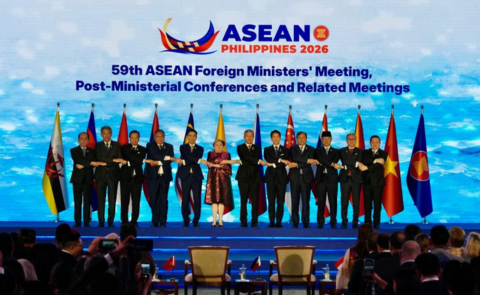
The ASEAN Chair, the Philippines, hosted the ASEAN Foreign Ministers and related meetings in Manila between July 20 and 24, 2026.
Though ASEAN centrality is now often called into question, these meetings demonstrated that ASEAN remains central to the diplomatic architecture of the Indo-Pacific. The wide variety of regional and global powers present in Manila participated in ASEAN-led meetings but also in an intense programme of bilateral and plurilateral engagements.
The ASEAN Ministerial Meeting (AMM), the ASEAN Plus Three (APT), the ASEAN Regional Forum (ARF), the East Asia Summit (EAS) Foreign Ministers’ Meeting, and the Post-Ministerial Conferences (PMCs) with Dialogue Partners constituted the formal institutional diplomacy of the week. Added to these were the commemorative meetings marking the 50th anniversary of the Treaty of Amity and Cooperation (TAC), a peace and cooperation pact signed by the original founders of ASEAN, which collectively reaffirmed ASEAN’s convening power in the region.
ASEAN continues to avoid being forced into difficult choices between the U.S. and China. Expectedly, the Joint Communiqué of the AMM[1] did not contain headline initiatives, instead focusing on economic resilience, it being on par with regional security concerns. Current geopolitical crises of food and energy security, digital transformation, resilient supply chains and climate-friendly growth received as much attention as traditional political issues like the SCS, Myanmar and the West Asian crisis. ASEAN recognises that strategic competition is now conducted through supply chains, technology and economic security, rather than through military competition alone.
Myanmar remains ASEAN’s central challenge. While Myanmar’s foreign minister was not invited, ASEAN maintained its commitment to the Five-Point Consensus. This reflects both the steadiness of ASEAN diplomacy and its limitations. Without abandoning engagement with Myanmar, which has continued informally in recent months,[2] ASEAN institutionally wishes to preserve the framework that permits gradual engagement without completely isolating the country.
Perhaps the most significant aspect of the meetings was the commemoration of the 50th anniversary of the Treaty of Amity and Cooperation, which, in many ways, underpins ASEAN centrality. The TAC remains ASEAN’s principal normative treaty. It binds parties to the peaceful settlement of disputes, non-interference, sovereign equality and the renunciation of the use of force.
It has now been acceded to by over 50 countries,[3] making it one of the world’s most widely adhered-to regional treaties. The Golden Jubilee of the TAC demonstrated ASEAN’s influence, despite its limited military strength, through rule-making and norm-setting. TAC provides the common diplomatic space for engagement with a wide variety of partners. Several countries, including Sweden, Poland, Romania, and Lithuania, attended as newly acceding members. Oman and the Netherlands also participated. In total, 30 foreign ministers attended the commemoration, underscoring the importance attached to the anniversary.
The meeting in Manila also saw a significant shift in one of ASEAN’s fixed positions: having a moratorium on dialogue partners. For many years, there were only ten dialogue partners, including India, but in 2021, the moratorium was lifted to accommodate the UK.[4] Türkiye, in line since 2017 to become a full entrant to the partnership, is officially the twelfth dialogue partner. Now ASEAN can admit partners it sees as strategic to its interests, which, like Türkiye, may not be traditionally viewed as a Pacific power. By admitting Türkiye, ASEAN demonstrated its attractiveness as a diplomatic platform extending beyond Asia. Moreover, it reflects ASEAN’s desire to diversify its Dialogue Partnerships beyond the major powers. For Ankara, its “Asia Anew Initiative” has perhaps found its crowning achievement in becoming an ASEAN Dialogue Partner, thereby giving ASEAN a wider place in Eurasian diplomacy.
While dialogue partners remain important because they participate in the post-ministerial conferences and, in many cases, the East Asia Summit, they are not all on an equal footing. The European Union, Canada and the UK do not participate in every ASEAN-led meeting, but they regularly attend the ASEAN Regional Forum (ARF) and the ASEAN Plus One Foreign Ministers’ Meetings. The UK was admitted to the ARF this year. By expanding this diplomatic space, ASEAN is seeking to engage a wider spectrum of partners beyond the traditional dialogue partners.[5]
Several middle powers like Brazil, Germany, France and the UAE also participated through sectoral partnerships, observer arrangements and bilateral consultations. This demonstrates ASEAN’s gradual evolution from a relatively closed regional organisation into a diplomatic hub where many countries gather annually.
Indeed, countries now attend the ASEAN meetings not only to engage ASEAN Member States but also to meet one another. This parallel network of meetings has become an important corollary to the formal ASEAN agenda.
The ARF, which meets only at the Foreign Ministers’ level, remains Asia’s only inclusive security mechanism. It brings together ASEAN members and partners and also includes North Korea, Mongolia, Papua New Guinea and South Asian countries such as Pakistan, Sri Lanka and Bangladesh.
The ARF focused on current concerns, including maritime security, cybersecurity, counter-terrorism, humanitarian assistance and disaster relief (HADR), and transnational crime. Its Chair’s Statement[6], reflecting the views of 27 members, carefully avoided language that might appear to favour either the U.S. or China, particularly on the South China Sea. Instead, it reaffirmed freedom of navigation, the peaceful settlement of disputes and respect for international law.
This balancing act is ASEAN’s hallmark. Although its usefulness is often questioned, ASEAN recognises that it cannot resolve great-power rivalry. Through the ARF, however, it seeks to prevent that rivalry from becoming a source of regional instability. Whether it succeeds is an open question.
The East Asia Summit Foreign Ministers’ Meeting serves as the precursor to the 49th ASEAN Leaders’ Summit in November 2026. Unlike the ARF, participation is limited to the 11 ASEAN countries and the eight Dialogue Partners that are also members of the EAS and ASEAN Defence Ministers Meeting Plus (ADMM-Plus).
The EAS focused on longer-term strategic issues, including economic security, maritime connectivity, digital cooperation, energy transition and emerging technologies.
The Indo-Pacific featured prominently, although ASEAN continues to interpret it through the ASEAN Outlook on the Indo-Pacific (AOIP), emphasising inclusiveness, openness and cooperation rather than alliance politics. For most EAS participants, this remains an acceptable framework.
Perhaps one of the major achievements of the meetings was ASEAN’s ability to maintain strategic balance. The U.S. and the other Quad partners, including India, reiterated their support for ASEAN centrality, while China emphasised economic integration, regional stability and continued negotiations on the Code of Conduct in the South China Sea, recognising that progress now largely depends on ASEAN Member States.
ASEAN’s success lay in accommodating both the American and Chinese narratives without fully endorsing either. This careful balancing remains central to ASEAN’s strategy of inclusive regionalism, recognising the importance of American security engagement while acknowledging Southeast Asia’s deep economic interdependence with China.
Russia’s participation followed closely after the Russia-ASEAN Summit in June. It reflected Moscow’s determination to remain an Indo-Pacific power despite its present strategic preoccupation with Europe.
Foreign Minister Lavrov reiterated Russia’s support for ASEAN centrality while advocating a broader Eurasian security architecture. Russia’s economic engagement with ASEAN remains modest compared with China, India and Japan. Nevertheless, ASEAN-led meetings continue to provide Moscow with valuable diplomatic space to engage partners who may not otherwise interact with Russia extensively.
An interesting development was the Quad Foreign Ministers’ Meet on the sidelines of the ASEAN meetings. Significantly, the meeting took place within the ASEAN process rather than outside it, emphasising that all four Quad members are Dialogue Partners and East Asia Summit participants.[7]
The Quad has consistently supported ASEAN centrality and has been careful to demonstrate that it is complementary to, rather than competitive with, ASEAN-led institutions. It continues to focus on practical cooperation in maritime domain awareness, resilient supply chains, critical technologies and HADR. Its brief communiqué recognised ASEAN sensitivities and avoided portraying the Quad as an exclusive security alliance, instead presenting it as a strong partner of ASEAN.
Indian diplomacy perhaps best illustrated the continuing importance of ASEAN-led forums. External Affairs Minister Dr S. Jaishankar was busy, participating actively in the ASEAN-India Post-Ministerial Conference.[8] The ARF and EAS meetings, as well as numerous bilateral meetings with ASEAN members, China, Russia, the European Union, the UK, New Zealand, Oman and others, besides the Quad Foreign Ministers’ Meeting.
India increasingly regards ASEAN-led forums as the diplomatic fulcrum of its Indo-Pacific engagement, enabling bilateral, plurilateral and multilateral diplomacy to be conducted simultaneously at a single venue.
The Manila meetings, coming amid continuing crises in Ukraine and West Asia, demonstrated that ASEAN centrality has not gone out of fashion. Neither the U.S. nor China, despite scepticism about ASEAN’s effectiveness, wishes ASEAN institutions to disappear. Russia, Japan, Australia, the European Union and the UK likewise continue to use these meetings as valuable platforms for Indo-Pacific engagement.
India, too, has used these forums effectively across multiple diplomatic tracks, contributing increasingly to the evolution of regional norms.
The real success of the Manila meetings did not lie in dramatic declarations but in the sheer intensity and diversity of the engagements. They demonstrated that ASEAN-led forums are an indispensable platform where competing powers can communicate, cooperate and manage differences even as strategic divisions deepen across the Indo-Pacific. This convening function remains ASEAN’s greatest contribution to regional stability.
Gurjit Singh is a former Indian Ambassador to Germany and author of The Durian Flavour: India, ASEAN and the Act East Policy. He is currently promoting the impact investment movement for implementing SDGs in Africa.
This article was exclusively written for Gateway House: Indian Council on Global Relations. You can read more exclusive content here.
Support our work here.
For permission to republish, please contact outreach@gatewayhouse.in
© Copyright 2026 Gateway House: Indian Council on Global Relations. All rights reserved. Any unauthorised copying or reproduction is strictly prohibited.
References:
[1] Association of Southeast Asian Nations (ASEAN), Joint Communiqué of the 59th ASEAN Foreign Ministers’ Meeting, July 21, 2026. https://asean.org/wp-content/uploads/2026/07/FINAL-Joint-Communique%CC%81-of-the-59th-ASEAN-Foreign-Ministers-Meeting-21-July-2026.pdf
[2] Ministry of Foreign Affairs of the Kingdom of Thailand, “Informal Meeting of ASEAN Foreign Ministers with Myanmar and the Extended Informal Consultation on Myanmar”, July 12, 2026. https://www.mfa.go.th/en/content/informal-meeting-asean-fms-myanmar-eic-120726-en
[3] The Treaty of Amity and Cooperation in Southeast Asia (TAC), ASEAN
[4] Singh, Gurjit. “India–Japan Strategic Partnership: New Opportunities in a Changing Global Order.” Rajasthan Foundation, 2025. https://www.rajraf.org/10282/uploads/article/1034/3_Gurjit_Singh.pdf
[5] Our Communities, ASEAN.org, https://asean.org/our-communities/asean-political-security-community/outward-looking-community/external-relations/
[6] Association of Southeast Asian Nations (ASEAN), “Chair’s Statement of the 33rd ASEAN Regional Forum,” July 25, 2026. https://asean.org/chairs-statement-of-the-33rd-asean-regional-forum/
[7] Ministry of External Affairs, Government of India. “Joint Press Release on Cooperation with ASEAN by the Quad Foreign Ministers.” July 22, 2026. https://www.mea.gov.in/press-releases?dtl/41494/Joint_Press_Release_on_Cooperation_with_ASEAN_by_the_Quad_Foreign_Ministers
[8] Ministry of External Affairs, Government of India, “EAM’s Remarks during ASEAN–India Foreign Ministers’ Meeting (July 22, 2026),” July 22, 2026. https://www.mea.gov.in/Speeches-Statements?dtl/41496/EAMs_remarks_during_ASEANIndia_Foreign_Ministers_Meeting_July_22_2026