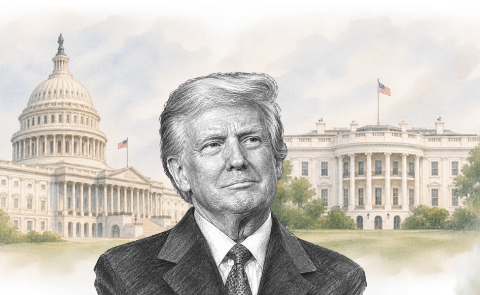
On November 3, the Democratic Party clobbered the Republican Party in midterm elections, with huge majorities in the House of Representatives (259 Democrats, 176 Republicans) and Senate (55 Democrats, 44 Republicans).[1] Up to 30 states are expected to have Democratic governors,[2] and 24 state legislatures are said to be under complete Democratic control.[3]
This was no ordinary midterm election in which the incumbent party lost seats. It was a Democratic landslide with implications for governance and the direction of the country for years to come. The results mark a striking rejection of President Donald Trump, his policies, and the country’s current vector. Inflation, the high cost of living, perceived corruption, the unpopular war with Iran, and harsh actions by U.S. Immigration and Customs Enforcement (ICE) are widely cited as decisive factors.[4]
While there is euphoria in much of the U.S., the implications for foreign policy changes are limited: The future sound and fury will be mainly in domestic affairs. Expect various Congressional investigations, with the power of the subpoena, directed at the Trump family business interests, including but not limited to cryptocurrency; monument and construction activity in Washington, DC; the ethics and legality of acceptance of a Qatari Boeing 747 as Air Force One; and the relationship of technology companies and the U.S. government.
Expect also, more stringent oversight of certain industries such as technology, banking and healthcare. Congressional calls for the investigation of Nvidia and suspected Chinese espionage, the appointment of Senator Elizabeth Warren to head the Senate Committee on Banking, Housing and Urban Affairs, and the naming of Senator Bernie Sanders to head the Senate Committee on Health, Education, Labor and Pensions are signals of an intensified regulatory environment to come.
Regarding foreign policy, a Democratic Congress will likely seek to moderate tariffs still in effect and to liberalise H1-B visas for skilled workers. It will likely propose more military support for Ukraine, now constrained by depletion of offensive and interceptor missiles such as the Patriot, THAAD and Tomahawk[5] in the Iran war, and it will likely encourage a more moderate tone in relations with NATO. Congressional pressure on Israel to achieve a peace settlement in Gaza is also likely. Expect a tougher mentality toward both Russia and China to be expressed by a Democratic Congress, which will nonetheless prefer multilateralism versus “America First” in its dealings with much of the world.
Before the new Congress begins on January 3, a grand effort by Trump to bring Ukraine, Russia, and Europe to the table for a potential security agreement cannot be ruled out. Further, at the Nov 18-19 APEC summit next week with President Xi Jinping of China, Trump may try to conclude a major trade deal. He may also decide to escalate the Iran conflict with further strikes on nuclear infrastructure, its military industrial complex, missile batteries and radars.
Although the President will face a hostile Congress, he is still the Commander-in-Chief as well as the nation’s chief diplomat, a practitioner of personal diplomacy. The President also retains the power of the veto, with two-thirds of each house of Congress required for an override, which is quite unlikely.
While the Senate can hold up confirmation of judicial and executive branch nominees to obtain policy concessions, the President will likely continue to wield much power, governing by executive orders where possible. Further, the elevation of Stephen Miller – viewed as a principal architect of the ICE policies – to White House Chief of Staff is a signal that the President is doubling down and will not hesitate to pursue confrontation.
President Trump’s once-excellent rapport with Prime Minister Narendra Modi has soured due to tariffs, Modi’s unwillingness to acknowledge a U.S. role in ending the aerial conflict of May 2025 with Pakistan, and his lack of endorsement of Trump for the Nobel Peace Prize. It is difficult to see how this interpersonal dynamic will change in the next two years.
Observers of U.S. domestic politics can expect to see tumult within the Democratic Party, as centrist elements try to contain the so-called progressives, who aggressively stand for socialism, higher taxation of the rich, relaxed borders, defunding the police, social engineering, and government as the solution for America’s travails – all accentuated by mainstream media, which will feel that it has been re-enfranchised.
The Democratic Party will now have to govern rather than just oppose, and expectations from the public are high. Its divisions within itself may initially impede defining and acting on priorities. While the Democrats campaigned on the affordability issue, their initial focus seems to be on retribution, as evidenced by the failed attempt to impeach Secretary of War Pete Hegseth – for which 11 Democrats did not show up to vote for it.
While the Make America Great Again (MAGA) movement has been wounded and repudiated by much of the country, the societal resentments that created it continue. However, it remains to be seen if the Republican Party can recover from its travails by the 2028 presidential election with a platform that addresses the needs of the country.
Frank Schell is a former senior vice president of the First National Bank of Chicago and later was a management consultant. He was a lecturer at the Harris School of Public Policy, University of Chicago, and is a contributor of opinion pieces to various journals.
This article was exclusively written for Gateway House: Indian Council on Global Relations. You can read more exclusive content here.
Support our work here.
For permission to republish, please contact outreach@gatewayhouse.in.
© Copyright 2026 Gateway House: Indian Council on Global Relations. All rights reserved. Any unauthorised copying or reproduction is strictly prohibited.
References:
[1] NBC News. ‘U.S. House Elections 2026 Live Results: Democrats Win Control’. 16 November 2026. https://www.nbcnews.com/politics/2026-elections/house-results.
[2] Baldauf, Scott. ‘Democrats Have a Majority of Governors. That Could Have Political Ripple Effects.’ The Christian Science Monitor, 4 November 2026. https://www.csmonitor.com/USA/Politics/2026/1104/democrats-governors-midterms.
[3] Davis, Sarah. ‘Democrats Secure Majority of Statehouses for First Time in 16 Years’. Text. The Hill, 10 November 2026. https://thehill.com/homenews/state-watch/6211869-democrats-win-state-legislatures/.
[4] Editorial Board. ‘JD Vance’s Theory of Election Defeat’. Wall Street Journal, 4 November 2026. https://www.wsj.com/opinion/jd-vance-iran-war-2026-midterms-e3509fe1?st=7iGzH9&reflink=desktopwebshare_permalink.
[5] Cancian, Mark F., and Chris H. Park. Munition Inventories: An Update Amid Renewed War Risk. Center for Strategic and International Studies, 2026. https://www.csis.org/analysis/munition-inventories-update-amid-renewed-war-risk.